Victoria, British Columbia

Wednesday, August 3, 2016

We woke this morning to clouds and light rain, not uncommon weather according to last night’s server. The weather had been quite warm here just last week, 30 degrees C, or 86 F, which is unusual for Vancouver.

Undaunted, we grabbed our umbrellas and jackets and proceeded to board a  Harbour Air seaplane for Victoria. Although it was hazy, we were able to appreciate the many islands and countryside below. We noticed an observatory on the island as well as a fair amount of agriculture.

By the time we landed, the sun was out, making for lovely touring weather on Victoria.

We were only here for the day, actually about six hours, so we had to pack in as much as possible. There is so much to see and do – a plan of action is advisable. IMG_6218

We walked through the Victoria Conference Center on our way to the Empress Hotel. The center features several totems that celebrate the cultures and histories of its many indigenous peoples.

Built between 1904 and 1908, The Empress Hotel opened in 1908 and is designated a National Historic Site of Canada. It is a chateau-style hotel designed as a terminus for the Canadian Pacific’s steamship line. After the CP ceased passenger services, the hotel marketed itself as a resort for tourists. The location is lovely, located across the street from the harbor. Flowers were blooming all around the hotel.

The Empress is well known for its afternoon tea service, which it serves to more than 800 people daily. We were not among the customers today. Too much to do and too little time.

We walked north to find the The Victoria Public Market at the Hudson with its local artisans, farmers, fishers, restaurateurs and more. Here you can purchase fresh cheese, olive oils, seafood, vegetables, even delicious chocolates (yes we purchased some.) There was live music in the afternoon, and a display advertising holistic nutrition consultations.

Appetites whetted, we went in search of a Farm to Table restaurant I had read about,  located on the edge of China Town, OLO Restaurant. All ingredients are grown or raised in British Columbia. The word “Olo” means “hungry” in Chinook jargon. I had Herb Gemelli Pasta with chili, grilled oyster mushrooms, and padano – absolutely delicious! Mark had fried eggs with sausage and hash brown cubes – also delicious!

Back to the harbor for a quick tour of the British Columbia Parliament Building.

There was a memorial quilt on display to missing and murdered Indigenous women and girls in British Columbia. The quilt was assembled earlier this year and unveiled in May. The quilt includes 90 patches, each representing a victim.

Canada has been conducting a national inquiry into the issue of murdered and missing indigenous girls and women, almost 1,200 cases reported over the past 30 years, but some believe the number is closer to 4,000. The homicide rates are also high for indigenous men in Canada.IMG_6261

Time to head back to Vancouver. For our return trip, we boarded a bus that is operated by BC Ferries. It was a longer trip,  but part of the adventure. The ferries carry people, automobiles, buses, and semi-trucks. Our bus drove on to the ferry, we debarked and headed to the top deck to enjoy the view and the weather.

When we reached Vancouver, we got back on the bus, it drove off the ferry and returned us to our hotel.



Posted in British Columbia, Canada, Victoria | Tagged | Leave a comment

And They’re Off Again!

Tuesday, August 2, 2016

It’s been several months since we’ve done any traveling, and I’ve been experiencing withdrawal pains.

Fortunately, we left this morning to get a fix, heading from Minneapolis to Vancouver, British Columbia. We’ll be visiting here for a few days before boarding a cruise ship to Alaska on Saturday.

When we checked weather.com, it said the temp would be in the low 70’s, not bad for Minnesotans. When we arrived, the web page said 61 degrees, but it was clearly quite a bit colder – verified when we heard the temp on the radio as 12 degrees Celsius, or about 53 degrees Fahrenheit, and rainy. We are Minnesotans, though, so we added some layers and braved the cold.

Our hotel is situated near the harbor (I just tried spelling this the British way – harbour – and autocorrect kicked in), and across the street from the White Caps FB Stadium. For those of you from the US, that’s soccer. The British Columbia Lions also play here – Canadian Football. The stadium has a retractable roof which allows blue sky over the entire field below; the all weather turf has a FIFA 2-star rating (son Sean will know what that means,) and there are other cool features that matter to soccer/CFL fans.

I was most impressed by the sculptures out front, four bronze statues of Terry Fox, a British Columbia native. He had lost a leg to osteosarcoma at the age of 19, and set out three years later from St. John’s Newfoundland, to raise money for cancer research, but his cancer recurred before he could complete the run, and he was forced to stop in Thunder Bay, Ontario, just 350 miles north of our home. Fox died the following year, a month shy of his 23rd birthday. The Terry Fox Foundation has raised over $500 million since then for cancer research, quite a legacy for that young man.

20160802_201816

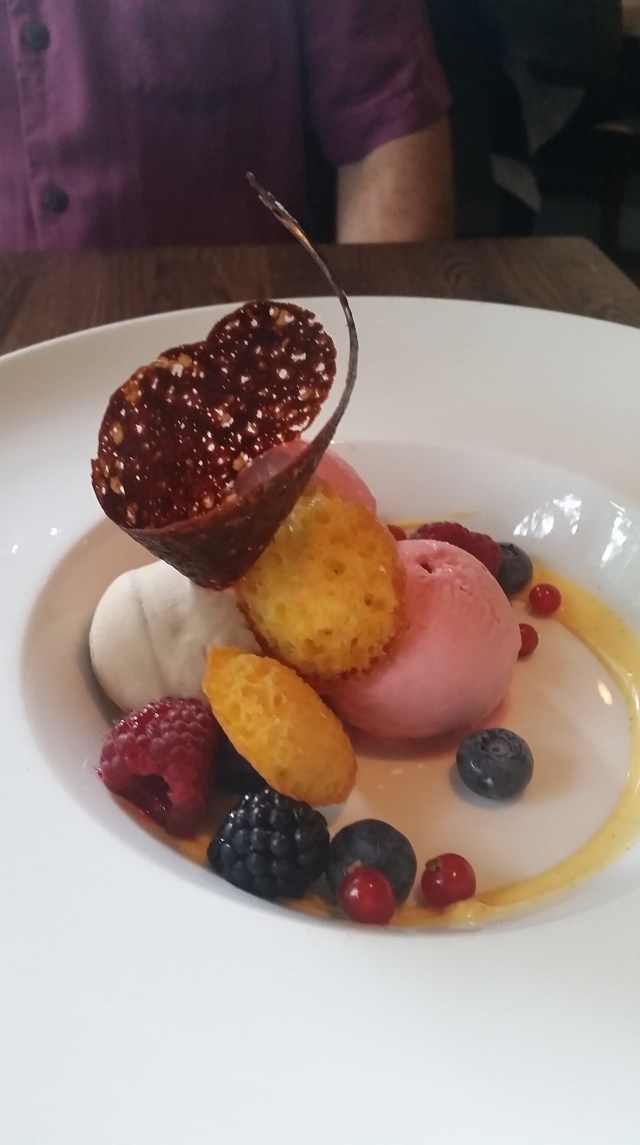
We had dinner tonight at a lovely Italian restaurant – Lupo Restaurant & Vinoteca, located just a couple of blocks from our hotel. We had a wonderful meal: sablefish for me and steak and fungi with chianti risotto for Mark, accompanied by a brunello wine and finished with blood orange and hazelnut gelatos. Yummy!

20160802_183349

Posted in British Columbia, Canada | Leave a comment

Book Report: “Rolling Nowhere”

I’ve been working my way through the road trip books listed in an article in The Guardian titled On the Road: Mapping the Great Road Trips of American Literature by Marta Bausells. The latest is Rolling Nowhere: Riding the Rails with America’s Hoboes by Ted Conover.

I grew up not far from Britt, Iowa, the home of the annual National Hobo Convention. I was curious but my family never did go to it. The Hobo  culture was made to sound glamorous, a fallacy that Conover effectively debunks in his book.

Growing up, my family lived beside a railroad track, and often heard stories of hoboes going through town (Algona, Iowa.) Sometimes we’d see what we kids thought was evidence of a camp near the tracks. There were even rumors of a hobo that spent a lot of time in Algona by the name of Walkin’ Joe. An Algona native even wrote a book about him: Walkin’ Joe and the Midnight Marauders: A Memoir by Dennis Waller. It was an interesting read, mostly because it was about my home town.

Conover wrote this book about his experience in the summer of 1980. As a young anthropology student, he wanted to understand first hand what life was like as a hobo. At the time, there were still hoboes catching train cars, but those numbers have dwindled significantly, due in part to improved railroad technology and greater enforcement of policies.

Even in the hobo culture, there was a hierarchy: Hoboes at the top, tramps next, bums last. A hobo is a migratory worker or homeless vagabond; a tramp works only when forced to, and a bum doesn’t work at all. Racism reigns here as well: whites don’t associate with blacks, and they all hate Mexicans (true hoboes because of their migratory status.) Most are male, but there are a few, very few, women who usually are “married” to a male for protection.

Hoboes came from all walks of life. Some just couldn’t function in an ordered society, holding jobs, staying married. This could be due to mental health issues or PTSD for return veterans, not well recognized at the time.

There might be friendships, but usually not long lived, for the same reasons as listed above. Trust was often betrayed. Food, clothing, all of one’s possessions could be stolen by your “friend” as you were sleeping. Life on the road was always lonely and always unsafe. You might be tormented by children when you just wanted to rest a while; you might be hassled by the railroad “bulls” and by local law enforcement; you would probably be treated as less than human by storekeepers and mission staff (who’ve lost sight of the original meaning of the word charity – love.)

Conover took some photos while riding the rails, but they weren’t in the paperback book that I read. Fortunately, they are on the website, and they do help to bring the story alive. The people depicted in the photos don’t look a whole lot different from many you might see on the street, if you look at them.

Posted in Literature, USA Travel | Tagged , , | Leave a comment

Road Trippin’ Vk: Let it Snow!

When we left Sedona that day in late February, 2012, the weather looked clear to the north so we decided to travel via Jackson Hole to see the Grand Tetons. We took our last drive through Oak Creek Canyon, stopping at a lookout about half way between Sedona and Flagstaff. The views here were indeed stunning.

The terrain changes so much as we drive further north. From red rock desert to forest covered mountains, this truly is a beautiful country.

We stopped at Glen Canyon Dam at Page, Arizona. This dam is the second highest concrete-arch dam in the United States, second to Hoover Dam in Nevada. The dam was built as part of the Colorado River Storage Project, and became operational in 1963. Lake Powell, created by the dam, filled over the next seventeen years, and it has become a major recreational spot, visited by around 2 million people per year

The dam generates 1.3 kilowatts of electricity. Over 15 million gallons of water can pass through the power plant each minute.

The weather still looked good when we arrived in Salt Lake City that night. The next morning, though, there was snow and wind forecast for Jackson, so we changed our plans to drive across Wyoming.

We did visit Mormon Temple Square to look around, but nothing was open that early. The square covers three city blocks, including the Temple, Tabernacle and Family History Library.

We also stopped at the Great Salt Lake just so I could take a look and taste the water – salty and brackish, ick! The wind was very strong, blowing sand across the road, and it was difficult to walk or even to stand up.

The drive across Wyoming on I80 was mostly a white-knuckle experience. We had driven about 100 miles when the snow started. With the high winds (gust of 50 mph,) we soon ran into white-out conditions, such that we couldn’t even wee where the exits were. Driving very slowly, and with hazard lights on, we finally pulled over and waited for things to clear a bit. Half an hour later, we started out again. Drove another hour and pulled over again for about an hour. Headed out again, wondering if the freeway would be closed (it probably should have been.)

After seeing one semi flipped over, another semi and several cars in the ditch, and when the road got very icy, we checked the road conditions online and learned that there were black ice conditions further down the road. We gave up, used the smartphone to reserve a room in Rawlins, and were very grateful that we did. The motel lobby was full of people looking for a room that night. We covered only 300 miles in seven hours that day.

The next morning, we left the hotel only to learn that I80 had been closed during the night. Rumor was that it was mostly to allow accident cleanup. We found a nice restaurant, Cappy’s in Rawlins, and had comfort food for lunch – hot beef and hot hamburger sandwiches – really good! If you’re ever in Rawlins, I recommend you dine at Cappy’s.

I80 was opened up shortly after noon, and we took off again. There appeared to be hundreds of semis on the road – all backed up from the previous day’s storm.

It sure was good to get back home. This trip reinforced my opinion that I never want to live any place where there are gates that can be used to close the freeway entrances due to snow. Unfortunately, we do have a few in Minnesota, but not too close to home.


Posted in USA Travel, Utah, Wyoming | Leave a comment

Happy Birthday, Interstate Highway System

June 29, 2016

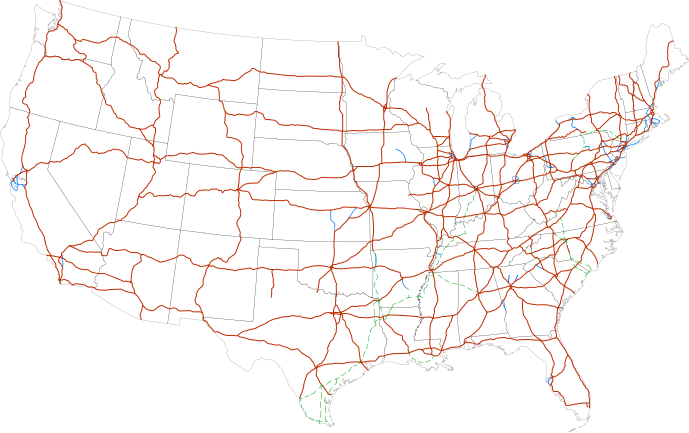
President Eisenhower signed the Federal-Aid Highway Act on this date in 1956, sixty years ago, back in the day when Congress could actually pass a piece of legislation that benefited more than just their own constituencies, or just themselves. The law authorized the construction of 41,000 miles of The Interstate Highway System. Eisenhower’s goal was to make transportation more efficient and make it easy to evacuate big cities in case of an atomic attack.

The original portion was completed 35 years later. Today, there are more than 47,000 miles of interstate highway, making much of our country accessible to us road trippers.

The federal government allocated $26 billion to pay for the roads. This was to be 90% of the total cost, funded by a gas tax. The total cost of construction has been estimated to be over $500 billion in today’s dollars.

This wasn’t the first piece of legislation dealing with highways.The first Federal Aid Road Act was enacted on July 11, 1916, one hundred years ago, to extend and improve our country’s road system. Funding was provided for rural post roads on the condition that they be open to the public at no charge. Farmers needed roads to bring their goods to market and the Postal Service needed to a way to deliver rural mail. Prior to this, many roads were little more than trails that were muddy in the rain and dusty the rest of the time.

There have been many bumps in the road along the way. These roads caused damage to some city neighborhoods, people were displaced. Activists were able to stop construction on highways and bridges in several states, resulting in some interstate highways literally going nowhere.

The Interstate Highway System was designed to be toll-free, so that all Americans would have access to good roads. However, there were some segments where toll roads were already operating. It would have been inefficient to construct another road next to the one that was there, so Congress approved the incorporation of toll roads into the system, with the requirement that no Federal highway funds be expended for their construction or maintenance. Thus, the Interstate Highway System does have about 2,100 miles of toll roads. Drivers can go around them, of course, but that’s not always convenient. On the other hand, you might enjoy the detour where the scenery is usually far superior.

East-west highways are assigned even numbers beginning in the south, and north-south highways are assigned odd numbers beginning in the west. Spurs, routes that go around a city, or into the city, are given an extra digit in front of the Interstate number. For instance, I94 is a principal highway that goes through Minnesota, connecting Fargo, ND to Hudson, WI. I694 skirts the Twin Cities to the north and east while I494 skirts the western and southern edges, and they meet east of St. Paul to feed back into I94. I394 goes from I94 on the east into downtown Minneapolis. Map of Twin Cities, MN

I won’t address all the issues that face our interstate system today. There are plenty of others who are engaged in those conversations.

As you head out on your Fourth of July road trip, just think about the Federal-Aid Highway Act of 1956 that made it all possible, at least for now.


Posted in Interstate Highway, Uncategorized | Tagged , | Leave a comment

Road Trippin’ Vj: Flying High

Among other things, Mark is fascinated with aircraft, so like a good wife, I rode with him to Valle, AZ, about 85 miles north of Sedona, hoping against hope that I would find something to do while he spent his several hours at the museum. It wasn’t easy, but I did find a trading post with some lovely turquoise jewelry. Did you know there’s such as a thing as white turquoise? It’s called buffalo turquoise, and a few pieces now reside in my jewelry closet. It’s called buffalo turquoise because it is as rare as a white buffalo.

Turquoise gets its color from the heavy metals in the ground where it forms. What most of us know as turquoise forms where copper is present, while the white turquoise forms where no heavy  metals are present. To date, only one vein of white turquoise has been found, on the Shoshone Reservation near Battle Mountain, Nevada. Apparently, other stones have been foisted off on gullible tourists as white turquoise. So, do I own white turquoise or something else? More importantly, do I really care as long as it’s unique and beautiful?!

Nope.

Mark spent his time at Planes of Fame, a fairly small museum which had some very interesting airplanes, including the only German Messerschmitt Me-109 in the US, as well as a Russian MiG. It was established in 1957 by Edward T. Maloney in Claremont, California. The museum later moved to Chino, CA, and added another location in Valle, Arizona.

Besides the Messerschmitt and the MiG, the museum in Valle is home to the Lockheed Constellation which was used by General Douglas MacArthur in WWII, and also to the plane that served as Air Force One to Presidents Truman, Eisenhower and Nixon at times. Any airplane can be designated as Air Force One – it just has to have the president on board.

When the museum acquired the Constellation, they had to be able to fly it back to Arizona, so the museum director worked to make it flight-worthy. Mark was able to tour the inside of the Constellation.

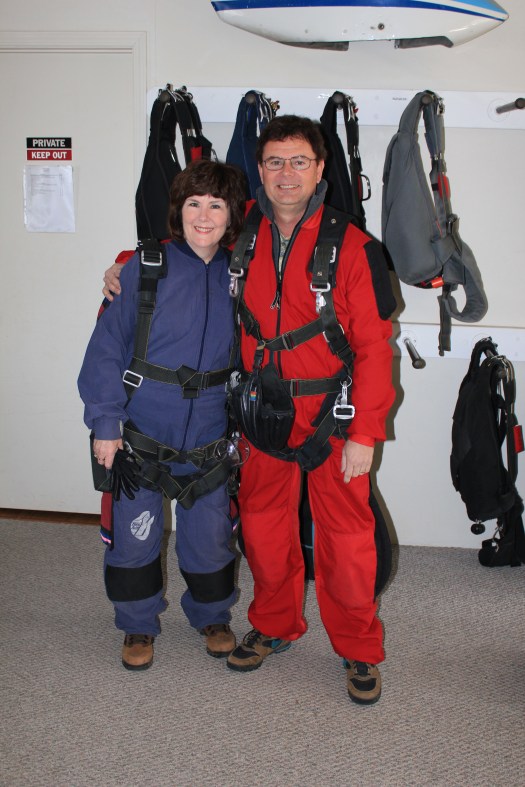
On February 22, 2012, Mark and I celebrated our 10th wedding anniversary. What could we do to leap into the next ten years? Leap? Dive? Jump? How about ski dive?

Red Rock Skydiving operates in Cottonwood, about 15 miles south of Sedona. Here, any brave soul can take a tandem jump after signing the longest disclaimer form I’ve ever seen. Basically, we had to promise that we wouldn’t sue if we were injured, our family wouldn’t sue if we were killed, the neighbors across the street wouldn’t sue, the dog next door wouldn’t sue. This may be a slight exaggeration, but only slight. It was several pages of disclaimers. We also watched a video explaining the various ways we could be injured or killed, and reminded once again, that we assumed all liability. If that’s not enough to deter you, then you get suited up and take a short training, which again explains the ways you can be injured.  Oh well, nothing ventured, nothing gained.

IMG_6871

We met our tandem divers, then crammed ourselves into the plane, seated on the floor, and then took off. We flew to about 14,000 feet above sea level, or about 10,000 feet above the current elevation. We were strapped to an experienced jumper who talked us through the entire experience, took photos, and even let us control the parachute for a while. Neither Mark nor I enjoyed spinning, so we stuck with slow turns. Since we were able to jump from the same flight, we were able to see each other as were diving – really cool.

The entire experience lasted about 1.5 hours, with the jump itself only lasting a few minutes. Those minutes are exhilarating though, as we free fell at 125 miles per hour to about 5,500 feet above the ground when the chute was opened, and we then floated the rest of the way. Our landing was pretty smooth. What an awesome way to celebrate our anniversary!


Posted in Arizona, Sedona, Uncategorized, USA Travel | Leave a comment

Road Trippin’ Vi:The Wright Experience

This post is dedicated to our favorite architect – Steve Kalkman. You’ve met Steve in many of my earlier posts. I’ve known him for about 25 years, since he came to work, fresh out of school, at the architectural and engineering firm I was working at. We went our separate ways, but reconnected some 20 years later when I met his wife Joan at another workplace. Since then, Mark and I have become close to Steve and Joan, and maintained a friendship even when they moved to Florida.

We’ve journeyed with them over the past 2.5 years as Steve has battled colon cancer, and we’ve cried as we’ve come to to grips with the fact that  he is losing the battle. He worked his way into our hearts and will continue to live there with us even after we say goodbye. I know that the many friends he has made all over the world would say the same.

We’re fans of architect Frank Lloyd Wright, so decided to head south to Scottsdale, to see his winter home of Taliesin West. Wright’s summer home was in Spring Green, Wisconsin, and was also called Taliesin. The name means “shining brow” in Welsh. Wright built his home on the brow of the hill, leaving the crown, or top, open.

Taliesin West was established in 1937 after Wright’s doctor told him he needed to be in a warmer climate than Wisconsin for the winter. It is situated on 550 acres in Scottsdale, and has been designated a National Historic Landmark.

The home here was a constant work in process for Frank Lloyd Wright. He would try things out for a wile, then have them taken down so he could try something else. He believed the two most important tools for an architect were an eraser and a wrecking ball.  Walls were built, moved, and removed over the years.

The Frank Lloyd Wright School of Architecture is housed here. The school was designed to train architects in his philosophy of “organic architecture,” and includes classrooms with lots of natural lighting, lodging rooms, a cabaret and dance studio as well as as Wright’s own living quarters. In the 1990’s, it became an accredited school of architecture, teaching the last two years of a baccalaureate program as well as offering comprehensive study towards a professional Master of Architecture Degree.

Taliesin West’s setting is stunning, and Wright’s use of the property was very creative. Although he believed that the outside and inside should look like they flow together, he was able to create spaces that were seemingly independent of each other. You can walk around a corner and be very surprised by the feel of a new space.

It was truly beautiful, but not always practical. Doorways are very narrow, ceilings are low, the furniture that he designed was aesthetically pleasing but not comfortable. We were not allowed to take photos of the living quarters or education rooms, but were able to in other areas.

We live in Minnesota, only 330 miles from the original Taliesin, but we haven’t visited yet. What’s wrong with us? The farther away something is, apparently the more attractive it is.

Posted in Uncategorized | Leave a comment

Road Trippin’ Vh: Petrified Forest and Painted Desert

Continuing with our road trip in February, 2012:

Petrified National Forest is about 115 miles east of Flagstaff. It is comprised of 170 square miles that extend to the north into the Painted Desert on the north. We drove almost 30 miles through the parks, and did a bit of hiking as well. Every corner we turned provided more reasons to “ooh” and “ahh.” It’s so easy to understand why this area was called the Painted Desert – it truly is a rainbow of earth, rock and foliage.

The Petrified Forest has over 50,000 acres of mesas, buttes, badlands, and grasslands, not to mention petrified wood.This site was declared a national monument in 1906 and a national park in 1962.Although it is illegal to take petrified wood from the park, it’s estimated that 12 tons are stolen from the forest each year, endangering the ongoing existence of this beautiful asset for the public. The petrified wood that you see in surrounding shops comes from private lands of reservation lands.

Deposited about 225 million years ago, these trees may have been toppled during a heavy rainstorm and swept downstream to where they rest today. They were buried under layers of silt, mud, sand and volcanic ash, protected from decay. Over time, mineral-laden water, carrying silica, percolated down through the layers of sediment, and saturated the absorbent dead wood. Silica crystals grew within the cell walls, filling the central cavity. Eventually the wood was completely replaced by silica, becoming a stone copy of the log. Trace minerals also soaked into the wood, causing the different colors – red, orange, blue, purple, black. etc.

IMG_7792

Natural bridge in Petrified Forest

In addition to the petrified wood, there were amazing views of the Painted Desert. Some formations look like striped teepees, with white layers of sandstone, dark layers of high carbon content, red layers of iron-stained siltstone, capped by clay. Some of the outcroppings are very smooth, others craggy. Sometimes, the smooth rocks are topped with stones.

The Painted Desert was named by an expedition under Francisco Vazquez de Coronado in his 1540 quest for the Seven Cities of Cibola, which he located about 40 miles east of the Petrified Forest National Park. After finding the cities, and seeing that they were not made of gold, he sent an expedition to find the Colorado River. On their way, they passed through this area, and named it “El Desierto Pintado.”

Only a portion of the desert lies within the park. It is about 120 miles long and about 60 miles wide, about 7,500 square miles.

As in so many areas of Arizona, there are pueblo remains. Newspaper Rock is an archaeological site in the park which has over 650 petroglyphs covering a group of rockfaces. These petroglyphs were created by many peoples between 650 and 2,000  years ago.

If you look, you can find examples of modern petroglyphs as well. We humans do love to leave our mark.IMG_7795

Located near the Painted Desert Entrance is the Painted Desert Inn National Historic Landmark. It had been built in the 1920’s using petrified wood. It was renovated between 1937-1940 by the Civilian Conservation Corps, using adobe for the façade. The Inn operated until 1963. Slated for demolition in the mid-1970’s, public outcry resulted in the building being reopened for limited use in 1976. It was declared a National Historic Landmark in 1987.

The old buildings were extensively rehabilitated, and reopened as a museum and bookstore in 2006. There are restored murals by Hope artist Fred Kabotie. You can peek in the windows of some of the rooms to see what the rooms were like for travelers staying at the Inn – very cozy.

On our way back to Sedona, we saw billboards advertising Geronimo’s Trading Post near Holbrook, saying that they had the largest petrified tree in the world. Of course, we had to stop and see – it’s what we do. It was pretty darn big, but the biggest? Who knows. As long as we were there, we checked out the offerings of  souvenirs, much of which was pretty nice.

Posted in Arizona, National Parks, USA Travel | Leave a comment

Road Trippin’ Vg: Sunset Crater and Wupatki National Monuments

We were certainly getting our money’s worth from my National Parks Pass on this trip. If you enjoy visiting the National Parks and National Monuments as much as we do, you’ll want to invest in the America The Beautiful Pass. For $80, your pass will be good for a full year. The pass covers entry fees for you and three accompanying adults. When you reach age 62, you can purchase a lifetime pass for only $10.

The National Park Service turns 100 on  August 25, 2016. There will be events around the country to celebrate the service’s first century, and kick off the second.

Sunset Crater National Monument is located about 20 miles NNE of Flagstaff. Sunset Volcano erupted about 900 years ago, and spread a thick layer of lava, cinder and ash over 800 square miles. It’s the youngest cone of over 400 volcanoes in the area. Sunset erupted intermittently until about 1085 AD, when a final spew of red cinders gave the crater the fiery appearance for which it was named.

There are large areas of black, craggy lava flow, as well as plenty of black gravel. We drove for several miles through the park, seeing this black lava and gravel and scrub brush. The side of a mountain would be mostly black, with just a few trees and shrubs. Plant life always eventually reclaims the land.
Drive another fifteen miles or so, and you’ll come to Wupatki National Monument, a site that was first inhabited around 500 AD. Several cultures lived here, including the Sinagua, Kayenta Anasazi, and Cohonina peoples, and it’s difficult to determine which were actually responsible for building the pueblo.

The name Wupatki means Tall House in the Hopi language, and it refers to a multistory pueblo that comprises over 100 rooms, a ball court and a community room. The volcanic ash improved agricultural productivity and the soil’s ability to retain water. It’s estimated that about 2,000 people moved into the area during the century following the eruption, but the site was permanently abandoned by about 1225.

During the 1930’s, some reconstruction was conducted at Wupatki, and it was used as offices and lodging for park rangers. The reconstruction was removed in the 1950’s.

Posted in Arizona, National Parks, USA Travel | Leave a comment

Road Trippin’ Vf: Over Hill, Over Dale

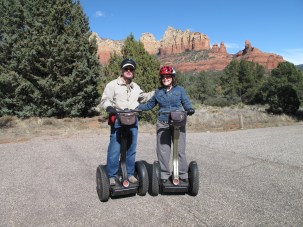
Time to do a little more touring around Sedona. We took a Segway tour with Adventures Out West. Before we set out, we went through a 15 minute training session to learn how to operate the Segway and become comfortable with it. Rather than touring the normal tourist areas, we went through some of the neighborhoods in the upper part of town. We were treated to some phenomenal views.

IMG_7626

Riding a Segway is pretty easy as long as you remember to keep your balance and don’t get too close to any obstacles. For instance, if you get too close to a curb, you will probably take a tumble. I speak from personal experience. Fortunately, I wasn’t going fast at the time and just suffered a bruise to the hip and some sore muscles (plus a bruise to my ego.) For a skilled skier like Mark, it was very, very easy. It was great fun, and we would definitely do this again.

After the tour, we had dinner at a local restaurant: Elote Cafe. It opens at 5 pm, and is so popular (as much for the sunsets as for the food,) that people start lining up around 4:00 to get a table. We arrived around 4:15, and managed to get a table by the window with a great view of the mountains. We watched the sunset while we dined. The meal was well work the wait.

Another day, we rented a jeep for the afternoon from Barlow Adventures and took to the hills. This is a great way to get to some out of the way places. It’s a bit bone-jarring, but a ton of fun. We drove on two different trails.

The first, Soldier Pass, was a bit adventurous, especially for the first time. Mark had done some driving on trails before, but it was a first for me. At times, the trail is so steep that you can’t see over the front of the jeep – all you see is the bright blue sky. Just go slow and the jeep will do the work.

We stopped a couple of times and did a bit of hiking as well. There is an area called Seven Sacred Pools, which are dips in the rock in a small canyon off the trail. If you don’t get out of the jeep, you won’t see them.

Another stop was at The Devil’s Kitchen sinkhole, which collapsed in 1981.Since there are areas that are still at high risk for collapse, we stayed well back from the edge – it’s a long way down.

Next trail was Schnebly Hill Road, which actually connects to I17 to the east, although the road was closed after about 4 miles because of snow accumulation. It’s a rough ride, and I definitely wouldn’t consider it a viable shortcut to I17. On this trail, we were treated to some amazing views of the canyon and of the City of Sedona. It was a day full of “oohs” and “ahhs” for sure. At the top of the trail, were were about one mile above sea level.

While driving back down, we saw several Border Patrol vehicles, including some pulling ATVs and moIMG_8012torcycles. Seems Sedona is pretty far north for border control issues, but it would be easy to hide in this wilderness if you are trekking cross country from Mexico.


Posted in Arizona, Sedona, USA Travel | Leave a comment