Traveling from Colca to Puno

Friday, February 1, 2019

With all of the rain, the Colca River is rising rapidly, and roiling past the lodge and the hot pools. Some local hot pools are already flooded. Those at the lodge are still about one foot above the water level. If it rises enough to flood them, the lodge will have to shut them down until the river goes down, then clean and refill them.

Dry creeks fill up, new creeks are created, and they flow where they will, without regard to the inconvenience they may cause, like washouts for instance.

Each year in August, everyone celebrates and honors Pachamama all month, at the beginning of the sowing season. Pachamama is a fertility goddess of the indigenous people, and is identified with the Virgin Mary. During August, all of the people in the villages come together for a week to clean the canals and reservoirs. Each family also cleans their terraces. The people make sacrifices to Pachamama (food, figurines, small animals) to guarantee good soil for the coming year. Harvest starts in February. Potatoes are dried for storage – they can keep for many years. Other crops are stored as well for consumption in the winter. The name Colca means “storage.”

The sun was shining today – a lovely surprise! We have a 5-6 hour drive in high altitude. We hope it doesn’t rain or snow while on the route, or it will take longer. When we reached the volcano view at 16,000 feet, we could actually see some of them.

EAF8C825-BF8D-4F34-95AF-68B3F95ED8AA

Before leaving, Jaimie’s mother stopped to give her something to deliver to her sister in Arequipa. From her hat, we can see that she is Collahua, and that Jaimie gets her beauty from her mother.

On the drive, we saw more ranches, and stopped at one where we spied some flamingos across the road! Until today, I thought flamingos were only tropical, but the Andean Flamingo lives at 15,000 feet. They are the rarest flamingos in the world. There was also a pretty duck with a blue bill, the silver teal, near the ranch. At another ranch, a veterinarian was vaccinating alpaca. There is water here, but plants do not grow very high. I found some lovely blue flowers that are about .25 inch in diameter.


A6A13E2C-5C88-4FE7-99CB-42F6EDE9304F

At a shop we stopped at along the way, Mark spotted the tiniest frog we’ve ever seen. What an eye he has! The tiny frog must have been less than a half inch long. I got down on my hands and knees to get a shot of it.

AA0BF36F-1F40-43F4-B4CB-479456F6943B

Much of our route today goes through high dessert plateau, looking much like New Mexico or Wyoming. We made a stop at Lake Lagunillas, at an elevation of 13,000 feet, often called the “Baby Titicaca,” where I purchased my second hat, alpaca fur. This beautiful lake is surrounded by hills of green and brown. Families who live around this lake make their living from trout fishing.

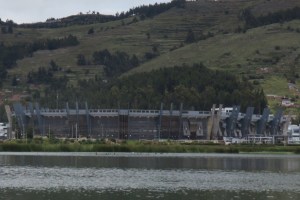
Puno is located on the shore of Lake Titicaca, and is the capital city of the Puno Region, at an elevation of 12,600 feet. We drove by a new soccer stadium that’s being built by the city. The city is applying to be accepted by FIFA, which might be a challenge because of the altitude. However, that could be an advantage for the local team. Our guide said that many soccer players actually want to train at altitude to give them more stamina.

AB8CDA71-DA70-4EEB-AF1D-5371109545E8

Most of the Puno District is mountain, and the rest jungle. Almost 70% of the world’s quinoa is produced here, as well as 50% of the alpaca and llamas. Recently, a very large lode of lithium was found near here, which is expected to be an economic boon.

We are staying at Hotel Sonesta, right on the lake, between two peninsulas. They make use of a couple alpaca to keep the grass short. There are also several guinea pigs running around, both mature and babies. They are delightful to watch. I do hope they’re safe from the cooking pot!


The hotel offers an unusual amenity to its customers – oxygen! Mark had been suffering from a cold for the past couple of days, so was especially susceptible to altitude sickness. We requested oxygen, and the staff brought a 5’ tank to the room for Mark to breathe from for ten minutes. He wasn’t completely cured, but he definitely felt better. I kind of wished I’d asked for a hit as well.

Posted in International Travel, Peru, South America Travel | Tagged , , , , | Leave a comment

Floating Islands of Uros

Saturday morning, February 2, 2019

At an elevation of 12,500 feet, Lake Titicaca is the world’s highest navigable lake. There are a few lakes at higher altitudes, some formed by melting glaciers, others inside volcanic craters, but none are considered navigable by large vessels. The name Titicaca means “mount of the puma.” This may be because the lake’s shape is similar to that of a puma. The Inca considered Lake Titicaca to be the birthplace of their people.

Straddling the border between Peru and Bolivia, Lake Titicaca (Lago Titikaka) is the second largest lake in South America, covering 3,200 square miles. It’s 120 miles long, 50 miles wide at its widest point, and 920 feet deep at its deepest spot. The lake never freezes, the temperature stays around 57 degrees year round.

DBD66DA4-52D3-4130-9191-236C41BF8B39Besides the natural islands, there are the Uros Floating Islands created by the Uros people. When the Incas came to the area, the Uros people retreated to the lake. Initially, they lived on boats, but over time, started building the islands that they currently occupy. The largest of the islands holds a watchtower that is constructed almost entirely of reeds.

The Uru or Uros, descended from the original settlers 4,000 years ago, consider themselves the owners of the lake and the water. They used to say that they had black blood because they did not feel the cold. Historically, they called themselves Lupihaques, or Sons of the Sun. Approximately 4,000 people live on these floating islands. They speak Aymara, a language borrowed from people they intermarried and traded with from the mainland. This language is even older than Quechua.

The islands are made of totora reeds which grow in Lake Titicaca. There are about 74,000 acres of reeds in the lake. The reed’s dense, interweaving, roots form a natural layer, 3-6 feet thick, that supports the islands, which are anchored with ropes attached to sticks driven into the bottom of the lake. New reeds are added to the top to replace the bottom ones as they rot away. An island lasts about 25 years, then a new one must be built. Each island supports 4-5 families. Each island has a lookout tower, which was used in the past, not only to watch for danger, but to communicate with other islands. Now they communicate with cell phones.

The bottom of the reeds is a source of iodine, and is also used to treat hangovers. The reeds are also a primary food source for the Uru people, and can be bartered for other foods, plus they fish and hunt birds.

The children attend school on the islands from kindergarten through grade school, then attend high school on the mainland. To get to school, they row themselves each day on reed boats. Also on the islands are a soccer field, medical clinic, and town hall.

We paid a visit to two of the islands. At the first one, Isla Kontiki, we enjoyed some demonstrations by a young man who lives on the island with his wife and daughter. The base of each island is about three feet of root, formed with blocks of roots that have been cut and then tied together. Several layers of reeds are place on top of this base, at least another three feet.

Besides fishing, the Uros hunt birds and ducks. They get many of their staples from the mainland. We did, however, see at least one potato plant on the island.

We visited the home of one family, that of the young man who did the demonstrations, along with his wife and 2 year old daughter. He speaks English, so was able to answer some of our questions. His wife makes beautiful tapestries, as shown below. One of them went home with me. The houses are not large, just one room. All cooking is done outside at a communal kitchen. Pots are placed on a large stone slab to prevent starting a fire on the floor. The islands have solar panels leased from the government to provide power. They make use of some current technology, like cell phones, while trying to maintain their ancient culture.

When we left the island, a few of the women sang to us. We boarded a reed boat to be rowed to the next island, which is more like a shopping center, with cafes and shops. The same young man we visited rowed along with another man. His young daughter came along for the ride. Puno residents often come here to enjoy a ride on the water and a meal on the island.


Posted in International Travel, Peru, South America Travel, UNESCO World Heritage Site, Wild Camels | Tagged , , | 1 Comment

Fruits of the Amazon

Wednesday afternoon, January 23, 2019

One of our guides, Ricardo, conducted a class on the fruits of the Amazon. We’ve had the opportunity to try many of them already, in juices and sauces, as well as fresh. Some of the fruits featured were (please forgive any misspellings): Granadilla (good for cholesterol), Mouriche palm fruit (also called Aguaje), Ivory Palm (Tagua), Fava Beans (enjoyed by monkeys), Kapok palm fruit (blood thinner, high in Vitamin A and Beta Carotene), Peach Palm (used to make fire water, or for hearts of palm), Cocona or yellow tomato (very tart, good in sauces), Charapita (tiny berry that is very hot), Cacao, and Copoazu (rich in calcium, magnesium and potassium), Macambo (also called monkey brain because of the pattern on the seed), and Anacardicia (related to the cashew).

The Tagua nut is also called vegetable ivory. There is a liquid inside the seed pod that, when left to dry for a few months, becomes hard enough to carve into jewelry and small sculptures. It also takes dye quite easily, and is very light weight and sturdy – a good replacement for plastic. I have several necklaces and earrings made from Tagua, and they are practically indestructible.

The Mouriche Palm fruit, Aguaje, is good as a juice, with vitamins A, B & E, but it has an even greater value as an oil, used in soaps, in massage, cosmetics and even as mosquito repellant. A quart of this oil can fetch $200 in the market. It’s also a favorite food for Macaws.

In our afternoon skiff ride on Lake Calvert, we were greeted by some Gray as well as Pink Dolphins. Unfortunately, we weren’t able to get any photos, maybe another time. We observed a Green Iguana basking in a tree overhead, then stopped to watch some foraging Spider Monkeys, but we were on the lookout for the smallest monkey in the world – the Pygmy Marmoset. Luckily, we found a few out looking for food. The Pygmy Marmoset’s body is only about 5 inches long, with a tail equally as long. Rather than having fingernails like other monkeys, the marmoset has long claws which allows it to gouge out pits in tree bark and access the sap.

We also saw a small Yellow-crowned Brushtail Rat in a tree hole. It has a head like a guinea pig, really cute, and is mostly nocturnal. We spied a mature male sloth sitting in a tree. It has a distinctive yellow/orange stripe which differentiates it from the female.

No rain this afternoon, but the surrounding thunderheads contributed to a gorgeous sunset. It was another good day in the Amazon.

We have been dining on gourmet meals all week, probably gaining 20 pounds. We have fresh fruits and vegetables every day. We frequently have freshly caught fish. Fresh juices, local cheeses and meats all come from this region. The homemade ice creams are usually sweet and tart, so refreshing. The pastry chef creates bread sculptures each day, iguanas, turtles, caimans and more. The kitchen crew has been very responsive to people’s dietary needs. One couple is vegan, and their dishes were among the prettiest I’ve ever seen – makes me consider switching to vegan myself. Mark and I hate cilantro (tastes and smells like soap or turpentine), so our meals were prepared without cilantro for the most part. To all of you cilantro lovers, it isn’t that we dislike the flavor that you get from the cilantro, it’s that we, along with about 20% of the population, have an enzyme that interprets the flavor in an obnoxious way. We can eat the cardamom berry without detecting a soapy flavor, it’s just the leaves that are an issue.

bf0152eb-8fac-4792-8ed0-0ea7cd3e9f5b

Posted in International Travel, Lindblad, National Geographic, Peru, South America Travel | Tagged , | Leave a comment

It’s Wet Here in the Amazon!

Wednesday morning, January 23, 2019

This is truly the wet season, with about 12 inches of rain per month. Meltwater from the Andes also contributes to the high waters. The high waters allow us to explore more widely by boat than we might be able to in the dry season. We do get wet, though, and this morning, we endured a deluge while exploring the Marayali creek, which, during high water, is a shortcut between the Marañón and Ucayali Rivers. The rain was so heavy, it was surprising that our skiff pilot could find his way back to the boat. We passengers simply put our heads down and hoped our cameras were safely dry. My binoculars did get moisture on one side, so I had monovision for the rest of the week.


Later in the morning, we visited the community of San Francisco to learn more about how the Ribereños live and work here. We watched a few demonstrations, including how to squeeze the juice from the sugarcane (Mark got to try his hand at this), how to separate the chaff from the brown rice that’s grown here (and feed the chickens at the same time), and how to weave palm fronds into thatch for their roofs. These thatch roofs do a very good job of keeping the rain out. Also, we saw smaller palm fibers hanging in the sun to dry. These fibers are dyed with natural colors, and then woven into bowls, birds, animals, napkin rings, and placemats for sale to tourists. Of course, I found a couple of things to purchase.


The community has benefitted from a program called Minga Peru,which trains locals in marketable skills, such as fish farming, agriculture, and weaving baskets and trinkets to sell to tourists like us. Minga Peru is a non-profit organization that promotes sustainable change for indigenous women and their communities. We heard from a few women and men about how this program has changed their lives, especially by giving women more autonomy, and teaching men to respect women’s power.


0d33bee4-5805-4b1a-95c2-fc8f4073514ed852851e-08f7-4535-a88f-541f48f38744

Around noon today, we sailed to the confluence of the Marañón and Ucayali Rivers, to toast the Amazon River. We begin sailing up the Ucayali River this afternoon.


Posted in Amazon, Amazon River, International Travel, Lindblad, National Geographic, Peru, South America Travel | Tagged , | Leave a comment

Amazon Natural Park and Nauta Creek

Tuesday, January 22, 2019

I was under the weather today, (might be a reaction to my malaria medicine, might be something I ate or drank) so remained back on the boat while Mark continued to explore. The first activity was a hike in the Amazon Natural Park, partly on canopy bridges. Besides mosquitoes, the group was greeted by birds, monkeys and tree sloths.

In the afternoon, some of the group took a skiff ride on Nauta Creek. Here, they were able to view a mature Three-toed Sloth foraging for food. Surprisingly, the sloth is closely related to anteaters and armadillos. This creature moves very slowly, spending most of its time in the trees, preferably the Cecropia tree. They come down to land only once a week to void at the base of a tree. The Three-toed Sloth takes the time to bury its excrement, making it vulnerable to predators. They can swim if necessary, but again, this makes them vulnerable.

f42ab5ba-7fe5-429c-bed9-d452817349cf

There was a beautiful Greater Ani that posed obligingly. This bird is related to cuckoos, it has a humped bill, white eyes, and blue-black wings. There were Horned Screamers, Wattled Jacanas and a Lettered Aracari, a member of the toucan family. The Lettered Aracari gets its name from the lines on its beak, which look like lettering.

Finally, they were entertained by a band of Common Squirrel Monkeys romping through the trees.

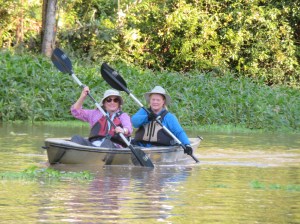
Friends enjoyed kayaking the Nauta Creek. 2f534a5f-0b63-422c-8a2a-e244c46664d4

Even though I remained at the boat, I also saw some wildlife – a Three-toed Sloth in a nearby tree, and a pod of Grey River Dolphins off the stern of the boat. I even saw one jump totally out of the water.

Posted in Lindblad, National Geographic, Peru, South America Travel | Tagged , , | Leave a comment

Colca Valley

Thursday early morning, January 31, 2019

There was no guarantee that we’d see the Andean Condor today. They glide on thermal currents, using the wind and the sun to soar. Today, it’s cloudy and chilly, but we arose early this morning to travel to Colca Canyon and try our luck.

Along the way, we stopped in the Village of Yanque, not far from Colca Lodge, to visit Immaculata Concepcion Church. This church was built in the 1800s, from white sillar stone. It had been damaged in an earthquake three years ago, so there are now wooden braces supporting the steeple and bell tower.

There is a lovely rock design leading up to the front door. Inside are several altars. At the first one, the Virgin Mary is dressed in local attire, including the hat, reflecting the Collahua culture. Different ethnic groups have their own style of dress, and each dress their female saints in that style. The hats of each village are designed to honor their gods.

Peru is 90% Roman Catholic. However, they have incorporated much of their own  religion into their practices. They still honor the gods of the Incas along with the Christian God.

Besides the hats, textiles vary from village to village as well, telling the story of the families, so it is ea know where the person comes from. Some blankets are used by women to carry their babies, and to carry the items they will need for the day, sort of an Inca backpack. They wrap their goods in the blanket, sling it behind their backs, and tie it in front. Woven belts also tell their stories.

Contrasting Backpacks

The male saints in the church look like Spaniards, complete with beards. Most of the local men did not have facial hair at the time, and they may have thought that all foreigners looked like the Spaniards. Our guide told us that her father is descended from Inca, and he doesn’t have facial hair.

We made a few stops along the way to enjoy the views, which are incredible. The green fields, the beige river, the brown soil all contribute to the beauty of the Colca Valley. This area is very fertile. There are many terraces, dating from the Incas, that are still being used in farming today. The highest cultivated terrace in Peru is near Lake Titicaca, at 15,000 feet. The Incas were very strategic in designing the terraces, taking advantage of the wind and sun, and planting crops where they would grow the best.

When the Inca came to an area, they first tried to conquer by intermarriage. If that wasn’t effective, they’d cut off the water supply. Battle was a last resort. The Inca did not force their beliefs on the people they conquered; rather they respected the conquered people’s right to practice their own religion, and maintain their own political systems. The Inca often adopted the technology of the people they conquered.

Quinoa is an important crop in Peru. At home, we’ve only seen the white variety, which grows from sea level to 12,000 feet altitude, red and black grow at higher elevations. The red and black are said to be of higher quality than the white. Quinoa leaves can be eaten like spinach. The seeds grow at the top of the plant, which can grow to 6 feet in height. The seeds must be rinsed five times to make them edible. The first rinse produces a poisonous liquid that can be used to wash clothing.

We’ll be looking for some of the red and black quinoa to take home with us. But for now, we’re headed for Colca Canyon and the Andean Condor.


Posted in International Travel, Peru, South America Travel | Tagged , , | Leave a comment

Traveling to the Colca Valley

Wednesday, January 30, 2019
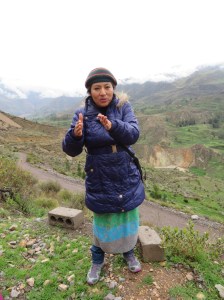
5f4e5730-ceb1-4f45-ad37-2e16af6405dcOur guide’s name is Jaimie. She said that this is not her Quichua name, but rather an “American” name. Her Quichua name is Naiwita. Many of the Quichua adopted American names because they were being discriminated against. Jaimie said that if she had used her Quichua name, she would not have been able to go to college. She also said that this is now changing for the better.

The Quichua make up the largest group of indigenous people in South America, about 2.5 million people. Their language is Quechua, which was adopted by several other groups of indigenous people, and it is now spoken by about 10 million people.

Jaimie was born in Colca. She told us that 80% of the people eat alpaca meat. Only about 15% eat lamb, and another 5% eat beef. They don’t like beef because it causes “wind in your belly.” Also, they drink Colca Sour up there, using cactus juice from Dragonfruit (Jugo de Sancayo) instead of the lemon juice. We sampled some of the fruit, which is indeed very sour, but when we drank Colca Sour, it was a little too sweet. We prefer the Pisco Sour.

The culture is still fairly Machismo where Jamie lives, in Chivay. When she was finishing high school, her father told her what career she should pursue. She said no, she wanted to go to university. They argued for 2 months, but she went to university. Her family was very concerned about her choice of career, spending time with “gringos” (any foreign person), fearing that she would be kidnapped and killed. Jamie has been working in tourism for ten years now, with no problems.

The ride to our next destination took about 4 hours, with a few short stops along the way. The volcanos in Arequipa are fogged in again today. We passed a huge cement factory outside of Arequipa. Volcanic rock is used in the production of cement.

We are climbing today, with a maximum altitude of 16,000 feet. Fortunately, our final destination will be at only 12,000 feet. By 13,000 feet, we could feel the difference, a little light-headedness and shortness of breath. We stopped for some Inca tea as well as coca leaves, which we chewed to help with the altitude sickness. I’ve been challenged by high altitudes in the past, so did what I could to prepare for the elevations we’ll be at for the next week, between 12,500 and 16,000 feet. I’m not able to take the altitude medication, but find that if I drink plenty of liquids with electrolytes, and drink the local coca tea in the morning, I can handle it fairly well. We routinely pack some Propel or G2 powder packets which can be mixed into a bottle of water. These are also helpful for excessive heat.

One of our traveling companions was miserable in spite of taking the altitude medication and drinking the coca tea. Some people are more sensitive to this change. It’s best to try to acclimate slowly if possible, by staying at one high altitude for a day or two before going to the next higher. That’s difficult if you don’t have the time.

Coca grows in rainforests, as small shrubs. The leaves are collected four times per year. Besides making coca tea, many people chew the coca leaves to help with altitude sickness, or use as a stimulant, not unlike caffeine. The leaves are safe to use; it would take 800 pounds of leaves to make one kilogram of cocaine.

People who live above 10,000′ have more red blood cells that do we who live lower. When they go to lower altitude, they experience a low altitude sickness, much like we experience at high altitude.

We drove through the Salinas Y Aguada Blanca Nacional Park, where we saw vicuña and alpaca grazing the road. Some years ago, the vicuña became endangered, so Peru declared them a protected species. They cannot be farmed, but must be allowed to roam free. Thanks to moves made by the Peruvian Government, vicuña are making a comeback.

The people who live in the park are shepherds. They use little cash, mostly bartering for the goods they need. Some of the women also sell items they have made to tourists like us.

We stopped at a small shop where we tried some Inca tea. This tea is made with several herbs and coca leaves. It tastes pretty good, and helped with the altitude as we climbed higher.

At 16,000′, the highest I’ve ever been, there’s a lookout where you can see eight different volcanos. That is, you can see them on a clear day. Today, we didn’t see any. Maybe we will when we come back through in a couple of days. This view is considered a sacred area. There are stone towers that have been built to honor the puma, condor and snake.

About an hour later, we had descended 4,000′ and arrived at Colca Lodge, our home for the next two days. The lodge is set in a valley, with the Colca River running past it. There are several hot spring pools on the grounds, fed by springs that are heated by the volcanos. We enjoyed a dip after lunch, and it was heavenly. The pools sit next to the Colca River, which is rolling and roaring over the rocks.

This is a small lodge, with about 50 rooms, all beautifully appointed. There is a spa on the grounds, where I had a rejuvenating massage after my visit to the hot pools. The lodge offers several activities, including horseback riding, hiking, a visit to a llama farm (which is accessed by a walking bridge over the river), or a visit to some archaeological ruins. I’m not sure we’ll take advantage of any of these activities in our short time here. We’re simply enjoying the opportunity to relax and get acclimated to the altitude. We can hear the river in our room, such a soothing sound.
Posted in Astronomy, International Travel, Peru, South America Travel | Tagged , , | Leave a comment

Exploring the Marañon River

Monday afternoon, January 21, 2019

We went out again with the skiff, stopping first at the park office to register as visitors. While waiting for our guide, several local children and mothers approached the dock, trying to sell us some products. They were selling tagua nut carvings and jewelry, and sculptures made by weaving palm fronds. These sculptures included butterflies, dragonflies, dolphins, jacana birds. Although we didn’t purchase anything today, we will definitely be taking something home with us.

Boating on the Rio Yanayacu Creek , we looked for grey dolphins and pink river dolphins. The pink dolphin is the largest dolphin in the world, and can usually be found where two bodies of water with differing densities meet. This pink dolphin does not have a dorsal fin like the gray, rather it has a bump on its back. Unlike the river dolphin, the pink are quite elusive, usually skimming near the surface, and not lifting high out of the water. We did see some signs of the pink dolphins, but never more than a bit of the body as they came up for air.

Our guide told us about some of the plants that grow along and in the river. Brackish lagoons, with a mix of salt water and fresh, are full of pink hyacinths as well as other plants, since there are few animals that feed off of them. This vegetation has roots that are not anchored to the ground, they can float up and down with the river level.

Although we didn’t see much of the dolphins, we did see several beautiful birds, including the horned screamer, cormorants, great egrets, hawks, wattled jacanas, a couple of short-tailed parrots, a potoo, and even some bats. There were many other birds, of course, but I can’t remember their names. Fortunately, the guides are updating a list of sightings that we can refer to, so we’ll be able to identify them later.

We particularly enjoyed the Yellow-Rumped Caciques with their weaver-style nests. They can mimic many other birds and animals, and like to build their nests in colonies, often by a large bee or wasp nest. The bees or wasps swarm in large numbers around the nests, discouraging potential nest raiders. There is a legend about the Yellow-Rumped Cacique and how it outfoxed a snake that had been wandering around a tree that held some cacique nests. This snake was very hungry and tired, and decided to creep up the tree to rest for a while. After its nap, the snake noticed the nests, and tried to to get at the eggs. It stuck its head into one of the nests, and the Cacique made a sound like an eagle. The snake jumped, fell against the wasp’s nest, then landed on the ground, where it was attacked by wasps.

We stopped to visit a local fisherman, a Ribereño who showed us some of his catch, including piranhas. Most of the fish were small, like panfish, but it was enough to feed his family. Ribereños are Spanish-speakers who live in small communities or farms in the Amazon lowlands. They use the river for washing, bathing, fishing and cooking. There are no roads through the forest, so the rivers serve as their highways. Over the years, the forest has come to reflect the ethnicity of the people because of the they way they select and use the wild species. There are rituals for the harvesting and preparation of plants used for medicinal purposes. Ribereños follow lunar cycles in the cultivation and harvesting of the crops.

After dinner, several of the crew entertained us with music and singing which we enjoyed immensely. This has been a very long day. In fact, I find it hard to believe that we’ve only been here one full day so far.

Posted in Amazon River, Lindblad, National Geographic, Peru, South America Travel | Tagged , | Leave a comment

Forest Walk in the Pacaya-Samiria Reserve, Amazon

Monday after breakfast, January 21, 2019

Following breakfast, we were treated to a hike in the Casual Forest, in a section called terra firma forest, meaning that the area never floods. It is, however, quite muddy, and we wear high rubber boots for the walk. We were accompanied by a local guide carrying a machete. He used it to cut through some vegetation, but was also ready to use it for protection if needed.

Here we learned about the Strangler Fig, a vine that slowly smothers its host tree, absorbing the tree’s nutrients and eventually killing the tree. This fig sends roots into the ground as well to find nutrients. The one we saw today is about 100 years old, it can grow to about 200 years. This fig had a beehive about half way up, and we could see the bees buzzing around.

There is a Porcupine Pine tree whose bark has very strong thorns that protect it from predation. One of our fellow travelers stepped on one of the thorns, and it penetrated the thick rubber boot she was wearing. Its wood has lighter stripes throughout, creating beautiful patterns in the trays and bowls carved by the local peoples.

A Walking Pine tree can move as much as eighth inches in a year, searching for sunlight. After a few years, it settles in one spot, with its long “legs” planted firmly in the soil.


We met a Green Anaconda, a fairly young one, only about 3 feet in length. The anaconda is not poisonous, but when it sets its fangs into its prey, the prey cannot escape. The anaconda then squeezes it and swallows it head first. The local guide picked it up with a stick so we could see its length and the coloration of the underside.

We found a tiny Red-backed Poison Dart Frog. This frog isn’t inherently poisonous, it gets its toxicity from eating fire ants.

Nasute termites build nests in trees, using a paste of chewed wood glued together with termite feces. These tiny termites generate a turpentine-like liquid which they spray on their enemies. Locals sometimes use this “turpentine” to repel mosquitoes, or to start fires. Our guide captured a handful so we could see just how small they are, and get a whiff of the turpentine odor.

The female tarantula is about twice the size of the male, one of which we encountered on our hike. The female often feeds on the male after mating, although some males do manage to escape this fate.

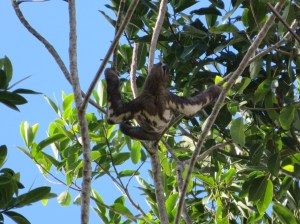
We also were treated to a slow performance by a juvenile Brown-throated Three-toed Sloth. When looking for food, the sloth often travels upside down on tree branches. After dining, it moves to the tree tops, where it can become easy prey for hawks. The sloth has two extra cervical vertebrae that allow it to turn its neck 180 degrees.

Posted in Amazon River, Lindblad, National Geographic, Peru, South America Travel | Tagged , , , , , , | Leave a comment

Pacaya-Samiria Reserve, Amazon

Monday morning, January 21, 2019

The Pacaya-Samiria Reserve is a protected region covering five million acres of forest in the Loreto region of Peru. Bordered by the Marañón and Ucayali rivers, it is an area of low hills and seasonally flooded forest covering about 15% of the total land mass of Peru. The Reserve is know for its biodiversity, and is home to pink dolphins, spider monkeys, South American turtles, jaguars, and alligators, plus hundreds of bird species. It is part of the National System of Natural Areas protected by the Peruvian Government.

Most of the region floods between October and April, and part of the rainforest remains flooded most of the year. We are visiting during the rainy season, which means the river is quite high. It has probably risen about 20 feet so far, but can go to 40-50 feet at its peak in May. We can see many branches and trees floating down the river.

The reserve is home to two species of endangered aquatic turtles: Charapa and Taricaya. Reserve rangers gather the eggs that are laid along the banks of rivers between July and December, then incubate them and return the little turtles when they are better able to survive.

There are 208 communities of ethnic Cocama-Cocamilla peoples living in the Pacaya-Samiria Reserve, with a population over 9,000. They make their living from fishing, farming, hunting and gathering, as well as making crafts for sale to visitors.

Our wake up call was at 5:30am so we could head out on the Marañón River to search for monkeys and birds before breakfast. The crew uses skiffs to transport us on the water. We’ll be exploring the area along the Marañón for a few days, then return to Nauta to begin sailing up the Ucayali River.

After heading down one tributary, we managed to see some noisy night monkeys, also called owl monkeys. We also spotted some Spider Monkeys, which are hard to follow because they move so quickly through the trees, looking for food.


Among the birds were a Silver-beaked Tanager, a Gray-backed Tanager, a Black Hawk, a Short-tailed Parrot, and a Wattled Jacana with several chicks. The Jacana has extra long toes which allow it to walk on top of the vegetation. Some people call it the Jesus Bird because it appears to “walk on water.”


Posted in Amazon River, Lindblad, National Geographic, Peru, South America Travel | Tagged , , , , , | Leave a comment