Road Trippin’ Ve: National Monuments and Sinagua Culture

We visited Walnut Canyon National Monument on February 14, 2012, the centennial IMG_7536birthday of the State of Arizona. Admission was free and we were asked to carry an Arizona flag on the trail as a way of saying “Happy Birthday.

Located about 10 miles from Flagstaff, Walnut Canyon has had human occupants over thousands of years. The first permanent culture, from about AD 600 to 1400, are called Sinagua, from the old Spanish name of Sierra de Sin Agua (mountains without water.) The National Monument was established in 1915 to preserve the ancient cliff dwellings. This site covers about 3,600 acres.

Taking the Island Trail from the Visitor Center, there are about 240 steps down to the site (and I’m convinced there were at least twice as many coming back up.) We weren’t able to walk the entire trail because half was closed due to snowfall the previous day. We were still able to see most of the site, which includes 25 cliff dwelling rooms along with fabulous views of the canyon.

On another day, we visited Tuzigoot National Monument, another location inhabited by the Sinagua peoples. This location is near Jerome and just outside Clarkdale, Arizona, about 65 miles from Walnut Canyon. The name “Tuzigoot” was taken from a near-by water source, and is the anglicized Apache word for “crooked water.”

Much of the land around Tuzigoot was covered with copper tailings from the mining operations in Jerome. In some places the tailings were as deep as 50 feet. A few years ago, the tailings were covered with dirt, then seeded, and the area is now covered with foliage.

Much of the excavation at the Tuzigoot site, which comprises 42 acres, was done in the 1930’s by out of work miners. Women were also employed by the Civil Works Administration to put thousands of pottery sherds back together.

Not far from Tuzigoot is Montezuma Castle National Monument, another Sinagua Culture settlement. This site was declared a site of historic and cultural significance by President Theodore Roosevelt on December 8, 1906. Much of the site was looted over the years, so very few artifacts remain.

When white settlers first saw the site, set into limestone cliffs, they mistakenly assumed it was Aztec in origin, even thinking that Montezuma himself may have live there, thus explaining the name. In 1933, a 45-50 room pueblo was excavated. Early visitors were allowed to access the structure, but public access was discontinued in 1951 because of extensive damage to the pueblo.


Posted in Arizona, National Parks, USA Travel | Leave a comment

Road Trippin’ Vd: Lowell Observatory

Before I return to relating the story of our 2012 road trip to Arizona, I want to let all of you know that Minnesota ranks #5 in WalletHub’s Analysis of 2016’s Best & Worst States for Summer Road Trips. That’s #5 of the best states. It seems we are #2 in road conditions and safety – must be a relationship to all of the road work that’s going on here, from the last snowfall of spring to the first one of fall.

Back to my story: Mark is fascinated with space and telescopes, so we took a drive up to Flagstaff, home of the Lowell Observatory, a non-profit research institution, established in 1894 by Percival Lowell. The location was chosen because its high altitude was conducive to good visibility. In 1958, the city of Flagstaff was the first city in the world to pass an outdoor lighting ordinance, significantly reducing light pollution, and it was designated a Dark Sky Community in 2001.

Before entering the buildings, we got to observe the sun at an outdoor telescope. Sunspot activity was fairly high at the time, so it was possible to see some spots on the sun. However, the time window was short due to clouds.

IMG_7505

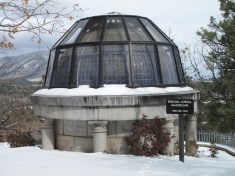
Percival Lowell Mausoleum

Lowell commissioned the first telescope in 1895, a 24-inch refracting telescope, built by Alvan Clark & Sons of Campbridgeport, MA. This telescope was used to create detailed maps of the moon in the 1960’s for NASA, maps that were studied  by Apollo astronauts as part of their training to go to the moon.Mr. Lowell’s mausoleum is located on the grounds, and is shaped like an observatory itself.

V.M. Slipher was an astronomer who spent his career at the Lowell Observatory, and made many discoveries using the Clark Telescope, including galactic redshifts, the first evidence of the expanding nature of the universe.

The Clark Telescope Dome is the oldest building at the Observatory. It was designed by Godfrey Sykes, and constructed in 1896  by local bicycle repairman, using local materials. It looks a bit like an upside down bucket. Originally, metal wheels were used to rotate the dome, but they wore out and were replaced with rubber Ford automobile tires in 1957.

The Clark is no longer used for research, but for education. Visitors can tour the Dome and the Rotunda Library which houses many artifacts from the Lowell’s history.


Pluto was discovered in 1930, using another telescope here. This telescope was built in the late 1920’s to search for the hypothetical ninth planet in our solar system. Clyde Tombaugh, an Observatory assistant, made the first recognized sighting of Pluto on February 18, 1930. Pluto enjoyed the designation of planet until 2006 when the International Astronomical Union voted to demote it, stating that it doesn’t qualify as a full-fledged planet, but only a dwarf planet.

At the time of our visit, the Lowell was working with the Discovery Channel to complete a 4.3 meter telescope, the Discovery Channel Telescope, which would vastly expand the breadth of their research capabilities. It was expected to be the fifth larges telescope in the continental United States. It was being constructed at a dark sky site in the Coconino National Forest, approximately 45 miles SSE of Flagstaff. The telescope was declared fully operational as of January 1, 2015.

TIME Magazine named the Observatory one of “The World’s Most Important Places” in 2011.

Posted in Arizona, Astronomy, USA Travel | Leave a comment

Road Trippin’ Vc: Cottonwood and Jerome, AZ

We did some exploring of nearby towns, Cottonwood and Jerome. On the way we stopped at a couple of wineries in the Verde Valley of northern Arizona for some tastings – Oak Creek Vineyards and Page Springs Cellars. Although several people told us Page Springs was the best, we preferred Oak Creek.

Oak Creek has been crafting wines since 2002, ten years at the time of our visit in 2012. The owner, Deb Wahl, was born in Croatia, spent most of her youth in South Africa, before coming to the US. While visiting Sedona in 2000, she and her family purchased ten acres and began planting grapes. The tasting room had a welcoming feel to it, and we had no complaints about the wines we tasted.

At the Page Springs tasting, the young woman behind the counter seemed to be more interested in visiting with a co-worker than discussing the wines we tasted. We were disappointed in the wines as well, they didn’t live up to their reputation. Maybe it was just a bad day for them? At least, we did get some nice wine glasses as souvenirs of the tasting, so not a total disappointment.

Cottonwood bills itself as “The Old Town City.” The town was founded in 1879, and was named for a circle of sixteen large cottonwoods growing near the Verde River. It was supposed to have the best bootlegging booze withing hundreds of miles (wonder how that compared to Minnesota 13?) The downtown has many lovely shops, and a person could spend several hours exploring. We did some olive oil and balsamic vinegar testing at Verde Valley Olive Oil Traders. We purchased a few oils and vinegars, and dinner that night consisted of bread, cheeses, meats, olives, oil and vinegar – pretty tasty.

From there, we drove to nearby Jerome, an old copper mining town, which bills itself as a mile high town. Jerome is an old copper mining town. Native Americans were the first miners, followed by the Spanish seeking gold. In 1876, the first Anglos staked a claim, and staked a claim, and mining continued until 1953. the first open pit mine was started in 1918 after an uncontrollable fire had erupted in one of the mine tunnels. Dynamite blasts rattled the hills, the surface began to shift and buildings began to crack. Entire sections of the business district slid downhill. There are still 88 miles of tunnels under the town, some as deep as 4.800 feet below the surface.

IMG_7551

Model of the town of Jerome and the underground tunnels

Jerome is now an artists’ community (some would say hippie town.) We checked out a few of the galleries and wandered around town for a while. The town is built on the side of the mountain, there’s a lot of walking up and down hill. Driveways, where they exist, are extremely steep. You want a car with good brakes to live in this town, like in Duluth, Minnesota, or Houghton/Hancock, Michigan (another community that flourished during bygone copper mining days.)

It was challenging walking up and down the streets until we became acclimated to the altitude. We had a good lunch at the Mile High Grill (verified by our GPS as being just shy of 5,280 feet.)

Jerome is home to the Jerome State Historic Park. This park is the site of the James. S. Douglas Mansion, built just above his Little Daisy Mine, and the Audrey Headframe Park. The mansion was designed as a hotel for mining officials and investors as well as for Douglas’ family residence. It featured a wine cellar, billiard room, marble shower, steam heat and a central vacuum system. It was constructed of adobe bricks made on the site, and is the largest adobe structure in Arizona.

Now it is a museum devoted to the history of the town of Jerome and the Douglas family. On our way to the mansion, we (actually Kathleen, as usual) managed to take a wrong turn and ended up driving on a one-lane gravel road down the side of one of the hills in Jerome and through the open pit mine – just another adventure. We chose to go back a different way.


Posted in Arizona, USA Travel, Wineries | Leave a comment

Road Trippin’ Vb: Sedona, Arizona

Sedona

Many movies have been filmed in and around Sedona, including a few I’ve actually seen, such as The Karate Kid, National Lampoon’s Vacation, Starman.  Gene Autry’s movie, The Strawberry Roan was filmed here, and there is a sidewalk plaque downtown to commemorate that. IMG_8015

The Sedona Film Festival is held here every February. This year was no exception, but we did not go to any of the movies, didn’t plan ahead. We also didn’t see any famous movie stars either, not for lack of looking (would have turned into gawking if we had.)

The Sedona area has attracted artists for decades, and has over 40 art galleries in the downtown area, and many more in the Tlaquepaque Arts and Crafts Village. It’s easy to understand the attraction for artists, with the surrounding red rock vistas. Actually, Native American artists lived around here for centuries, and there are many opportunities to see some of their work at nearby heritage sites and National Parks.

Tlaquepaque Arts and Crafts Village

Downtown Sedona

Sedona also attracts a few million visitors each year looking for the vortexes in and around Sedona (they actually spell it this way in Sedona.) These are defined as a place in nature where the earth is exceptionally alive with energy, and they are believed to be psychic places of power. There are four that are located in the town of Sedona. There are also innumerable shops, spas, psychic clinics, and more that will offer you the opportunity to part with your money to experience the healing energy. Take a mystical tour, purchase some healing stones or crystals, get a psychic reading or an aura photo. We didn’t do any of these things.

We visited the airport for the views there, which were spectacular! We went back another day to have breakfast there at the Mesa Grill. We’d heard that the breakfasts were very good there – it’s true.

Next stop was the Chapel of the Holy Cross, which was built on a twin pinnacled spur about 250 feet high, jutting out of a thousand foot red rock wall.The chapel has wonderful views of the surrounding areas.

The idea for the chapel first came to Marguerite Bruswig Staude in 1932 in New York City while she was observing the newly constructed Empire State Building. When viewed from a certain angle, a cross seemed to impose itself through the very core of the structure. She wanted to replicate that, and build a structure that would glorify God. While traveling through Sedona, she was struck by the beauty of the area, and decided that the chapel should be built there.

The building of the chapel was completed in April, 1956. Although part of the local Catholic diocese, Mass is not celebrated there, just a prayer service once a week.

Chapel of the Holy Cross


Posted in Arizona, USA Travel | Leave a comment

Road Trippin’ Va (or 5a)

This is the last in my series of past road trips, inspired by some recent books I’ve read about driving cross country.

In February, 2012, we drove from Minnesota south and west to Sedona for two weeks away from the cold and snow. On our way, we stopped first in Mitchell, SD to see the World’s Only Corn Palace. I’ve actually traveled that way many times, but never took the time to stop.

In the late 1800’s, several towns in the Midwest built crop palaces to promote their local products. The original Corn Palace, “The Corn Belt Exposition” was built in 1892 on Mitchell’s main street, to showcase the rich soil of South Dakota. It was rebuilt several times and the current design dates back to 1937. The exterior is covered in corn murals that are redesigned and replaced each year (except 2006 due to extreme drought.) The murals are designed by local artists.

The palace includes an arena for sports events, exhibits and concerts. If you are in the area in August, you might want to take in the Corn Palace Festival.

Admission is free, and the Palace is open most days of the year.

We didn’t make too many more stops along the way. In the winter, it’s always best to get as far south as you can as quickly as you can. Driving snow can hit anytime or anywhere, IMG_0007regardless of the forecast, as we experienced later in this road trip.
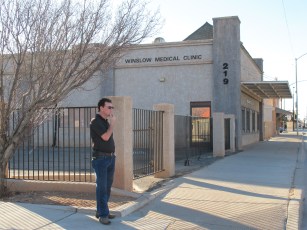
We did stop in Winslow, AZ, though so Mark could stand on the corner and look for a girl in a flatbed Ford, as referenced in The Eagles song Take it Easy. Turns out he stood at the wrong corner, but we were in a hurry, so didn’t see the statue and mural that are located at the corner of Old Highway 66 and North Kinsley Avenue. I guess we’ll just have to go back.

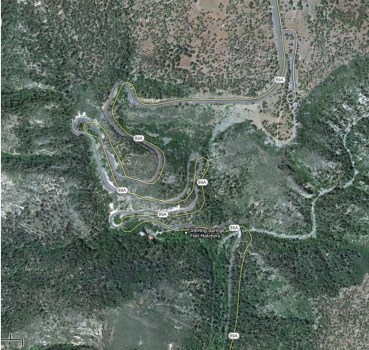
Oak Creek SwitchbacksWe drove south from Sedona on Highway 89A, which skirts the stunning Oak Creek Canyon. The Oak Creek Canyon Scenic Drive is about 14 miles long, and includes a two-mile stretch of switchbacks that inspired fear, but which I  came to enjoy driving by the end of our stay in Sedona.

We drove for three days before arriving at our Sedona condo just a few miles from the downtown area. We have a lovely view from our deck. Sedona has an ordinance that prevents homes from being built so high that they block the view of any of their neighbors. Some people get around this by locating on the side of a hill and buIMG_8021ilding down. There is apparently no limit on stories below grade. Also, bright colors are not allowed on exteriors, so Sedona has the only McDonald’s with teal colored arches.


Posted in Arizona, South Dakota, USA Travel | Leave a comment

Road Trippin’ IVh

Friendship

Friends Steve and Joan joined us for a few days at our Panama City Beach Condo. While they were visiting, we did some exploring and found a lovely park in the area. Panama City Beach Conservation Park, with 2,000 acres of wetlands and 900 acres of uplands, was established to protect natural resources and provide outdoor recreational opportunities. There are 24 miles of trails, and we hiked a small portion of that. It was a beautiful day for a hike.

Too soon, we bid farewell to our friends and to the beautiful beaches of Panama City Beach.

On our way back to chilly Minnesota, we stopped in Clarksville, home of the Clarksville Train Station immortalized in the Monkees song “Last Train to Clarksville.”

Shortly after we entered Wisconsin on I94, we saw a billboard for the World’s Largest Culver’s in Newville, WI. Never willing to pass up an adventure, we stopped for lunch even though it was only 10:30 in the morning. If you’re not familiar with Culver’s, it’s a Midwestern not-quite-fast food franchise, known for their Butterburgers and frozen custard which are pretty tasty. And, yes, this Culver’s size was impressive.

So, on this superlative trip, we saw the world’s largest truckstop, Lexington’s largest independently owned bookstore, the world’s smallest working still, and the world’s largest Culver’s. Not bad for two weeks.


Posted in Florida, USA Travel | 3 Comments

Road Trippin’ IVg: Panama City Beach, FL

Panama City Beach

We rented a condo on the beach here. It fronts on the gulf, and we could sit on the deck and listen to the surf – such a soothing sound. There was quite a storm the first night we were here, and we came upon several Portuguese Man of Wars that had washed up on the beach during the storm. It’s interesting to watch the gulls eat them. The gull picks one up in its beak and then washes it in any standing water it finds. Perhaps that washes away the poison? Apparently the tentacles, though dead, can still deliver a painful sting, so we made sure not to touch or step on any.

The man of war is not a jellyfish, but actually a siphonophore, a colonial organism made up of minute individual organisms called zooids, which cannot survive independently. In the water, the tentacles sting and kill adult or larval squids and fishes. These tentacles can be up to 98 feet long.

We drove to nearby St. Andrews State Park. The beaches here are gorgeous, sugar white sands, along the Gulf of Mexico. We spied a couple of jellyfish that had washed up on shore. They look like blobs on the sand, and it would be easy to miss smaller ones.

There are a couple of nature trails in the park that we checked out. Really, just another day in paradise.

On another day, we walked through Oaks by the Bay Park located in the old village of St. Andrews, part of Panama City. There is a rare four headed palm located in the park, the only one its kind known in the world. It is a Butia Capitata, or jelly palm. These trees grow very slowly, and it is unusual for one to have several arms like this one.

It’s always nice to end the day with a tropical drink at the local Margaritaville.


Posted in Portuguese Man of War, USA Travel | Leave a comment

Road Trippin’ IVf

Moving on from Nashville, heading to Huntsville, AL. We may have been through with the Bourbon Trail, but we weren’t through with distilleries. Jack Daniel’s is located in Lynchburg, TN, about 75 miles south of Nashville, on our way, so of course we stopped.Unfortunately, we stopped on a Sunday, so there was no sampling allowed aside from what we could absorb through our nostrils. Jack Daniel’s is located in a dry county. They can distill the product there, but can’t sell it. There is an exception: you can purchase one commemorative product from the distillery. Still, not on a Sunday.

Jack Daniel was born sometime between 1846 and 1850. His mother died when he was very young, and his father died in the Civil War. Jack didn’t like his stepmother and ran away from home at a young age. He was taken in by a local preacher and distiller, from whom he learned the moonshine trade. When the preacher was told by local prohibitionists that he must choose between preaching and distilling, he chose preaching. Jack purchased the distillery from him for $25. According to the story, Jack was only 13 when he acquired the distillery. By the 1880’s, Jack’s was one of fifteen distilleries operating in Moore County, and the second most productive of them all.

Jack’s whiskey received the gold medal for the finest whiskey at the 1904 St. Louis World’s Fair, and his product took off.

The distillery makes its own charcoal on site, which is used in the filtering process. Fresh spring water comes from their grounds as well.

You can purchase your own barrel of bourbon for only $9,000 – $12,000. Forty cases of whiskey (6 bottles per case) will be delivered to your home along with the empty barrel. If you can’t afford that, you can purchase a used barrel at the local Jack Daniel’s Market Store.

Our next stop was the US Space and Rocket Center in Huntsville, AL, where Mark spent several hours studying Werner von Braun’s and other German scientists’ accomplishments at NASA’s Marshall Space Flight Center in Huntsville, and examining the various rockets on display.

The center was opened in 1970, after the second manned mission to the lunar surface, and houses more than 1,500 rocketry and space exploration artifacts. The largest space spaceflight museum in the world, they offer Space Camp for children of all ages, as well as for adults and families. They also offer Aviation Challenge Camp geared toward fighter pilot training and survival skills. We may have to sign up. It’s never too late to start a new career.


Posted in USA Travel | 1 Comment

Road Trippin’ IVe: Grand Ole Opry

Grand Ole Opry

If you’re in the neighborhood, you should go. We are not country music fans, but decided we should experience this American icon, and we are grateful that we did.

This show is broadcast live over the radio, commercials and all. It made me think of Garrison Keillor’s “A Prairie Home Companion“, but without the ketchup or powdermilk biscuits. Also, it may have been a little too exuberant for Lake Wobegone’s bachelor Norwegian farmers.

The Grand Ole Opry show was founded by George D. Hay, and first broadcast in November, 1925. It was called “The WSM Barn Dance” at that time. Many country artists have launched their careers through the Grand Ole Opry.

The Opry has had several homes over the years, including the Ryman Auditorium in downtown Nashville, from 1943 – 1974. The Opry moved out of downtown Nashville to Opryland USA in 1974, with a new Grand Ole Opry House, but it is still broadcast from the Ryman during the winter months, so we were able to enjoy the show at the Ryman Auditorium.

FYI: “A Prairie Home Companion” was broadcast one night from the Ryman on June 4, 1994.

IMG_7167

Minnie Pearl Impersonator

A Minnie Pearl Impersonator entertained us for a few minutes before the show started. Minnie Pearl, born Sarah Ophelia Colley Cannon in 1912, appeared at the Grand Ole Opry for more than 50 years, from 1940 to 1991, about five years before her death in 1996. She always wore a flowered hat, with her signature price tag hanging off the side.

Performers at this evening’s show, in January, 2012, included Emmy Lou Harris, Vince Gill and a host of other entertainers we weren’t familiar with, like Craig Morgan and Shawn Colvin. I especially liked Shawn Colvin and purchased one of her albums when we returned home. We were entertained by 91 year old Jimmy Dickens (who passed away in January, 2015), Jim Ed Brown, Jean Shepard, and the Opry Square Dancers among others.


Posted in USA Travel | Leave a comment

Road Trippin’ IVd

After we left Wild Turkey, we took a scenic drive through what looked to us like Deliverance country. It was a one-lane gravel road, lined with garbage, sad to say. We tracked a sofa, its cushions and throw pillows along the road. We really questioned whether we should even be on that road, and hoped we wouldn’t meet another vehicle along the way. Nonetheless, it was part of our adventure.

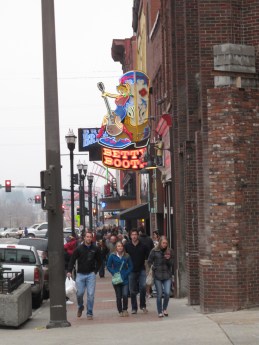
Nashville, Jan 21We stayed in downtown Nashville, across the street from the Country Music Hall of Fame and the Bridgestone Arena. We were just a block from Broadway, which is lined with Honky Tonks, and only a couple of blocks from the Ryman Auditorium. The Ryman was the former of the Grand Ole Opry and still hosts the show on occasion.

More about the Grand Ole Opry in another post.

We visited Andrew Jack’s home, The Hermitage, several miles east of downtown Nashville. Andrew Jackson was our seventh President, serving from 1829- 1837. Andrew and his wife, Rachel, purchased a 425 acre farm here in 1804, and built the mansion between 1819 and 1821. The home was heavily damaged by fire in 1834, so rebuilt the mansion that stands there now.

The Hermitage was an operating cotton farm during Jackson’s day, worked by slave labor as was normal in the south at the time, a lamentable chapter in our nation’s history. There are a couple of slave cabins on the grounds.

There are extensive gardens at the Hermitage, but we were visiting in February, so there was not much to see. Jackson’s grave and the family cemetery are also located on the grounds.

We next visited Belle Meade Plantation located several miles west of downtown Nashville. John Harding purchased 200 acres of land, and built the brick home in 1820. Harding farmed and raised thoroughbred horses, using slave labor. By 1860, the estate had grown to over 3,500 acres.

Most of today’s thoroughbred race horses can trace their lineage to horses at Belle Meade, including Secretariat and Seattle Slew. It’s said that every horse that has run the Kentucky Derby since 1990 is a descendant of the Belle Meade stables. It was a thriving operation until the early 1900’s when Tennessee banned both gambling and drinking, allowing Kentucky to gain the advantage in raising thoroughbred horses. People no longer went to the race tracks in Tennessee, and Belle Meade went downhill. and by 1906, all of the properties had been auctioned or sold off.

The state of Tennessee purchased the residence and eight outbuildings, on 30 acres, in 1953, then turned the property to the Association for the Preservation of Tennessee Antiquities.


Posted in USA Travel | Leave a comment