Road Trippin’ IVc: Kentucky Bourbon Trail

Kentucky Bourbon Trail

Our first stop on the Bourbon Trail was the Jim Beam Distillery located near Clermont, for a tour and samplings. Jim Beam is the largest distiller of bourbon in the world, accounting for 95% of total production, at least in 2012.

The business was founded in the late 1700’s by Jacob Beam, who started selling his father’s corn whiskey recipe in 1795. His first product was called “Old Jake Beam Sour Mash,” and proved to be very popular among the pioneers, farmers and traders living in Kentucky. The distillery  was called Old Tub at that time.

James Beauregard Beam was born in 1864, and took over the distillery in 1894. He survived prohibition by turning to coal mining and citrus farming, but returned to distilling after prohibition was repealed in 1933, and began selling bourbon again in 1934. Old Tub Distillery was changed to Jim Beam in 1943.

Jim’s daughter, Margaret’s son, Booker Noe II, was known as “The Innovator,” and he revitalized the declining bourbon category. Margaret’s grandson, Fred Noe, expanded their markets and was still involved in the business when we visited.

Heaven Hill Distilleries  was located in nearby Bardstown, so that was our next stop. This distillery was founded shortly after Prohibition ended, originally as “Old Heavenhill Springs.”  Joseph L. Beam, Jim Beam’s cousin, was the first master distiller. Jim Beam’s great great nephew, Craig Beam is the current master distiller. Clearly Bourbon is proud family tradition for the Beam family.

The original distillery was heavily damaged by fire in 1996. They were provided production capacity be fellow local bourbon labels, until it was able to purchase and adapt the Bernheim distillery in Louisville. Fermenting, mashing and distilling occurs at the Louisville location, but aging and bottling are out of the Bardstown location.

On our way to Nashville, we stopped at a couple more distilleries. The first was Four Roses Bourbon, which I thought had the best tour of the four that we went on. Four Roses is a small batch distillery, where they do everything from growing their own corn to building their own barrels from white oak trees grown on their land. We were able to observe, and smell, the entire distillation process.

Four Roses was founded by Paul Jones, Jr. in 1888. According to legend, he was enamored of a beautiful Southern belle. He sent her a proposal, and she replied that if the answer was yes, she would be wearing a corsage of roses at an upcoming ball. She arrived wearing four roses, and Paul names his Bourbon “Four Roses” in her honor. True or not, it certainly makes a good story.

Seagram’s purchased the Four Roses in 1943, but then decided to discontinue the sale of Bourbon in the US. Jim Rutledge became the Master Distiller in 1995, and worked tirelessly to return the Four Roses brand to the US. That did not occur until 2002, after Four Roses was purchased by the Kirin Brewery Company. Sales within the US began again in 2004.

Our fourth tour was at Wild Turkey Distillery, which was established in 1869 by the Ripy brothers, changed hands several times, and was most recently purchased by the Campari Group in 2009. The name came from a wild turkey hunt in North Carolina.

Wild Turkey has a long literary history, having been a favorite drink of the journalist Hunter S. Thompson and mentioned in two of his books. Other authors who mentioned Wild Turkey in their books are Stephen King, David Foster Wallace, Scott Sigler, and Patrick Neale. It has also featured in many films and television shows, indeed too many to mention here.


Posted in Bourbon, USA Travel | 1 Comment

Road Trippin’ IVb

The main purpose of this trip was to visit the Kentucky Bourbon Trail. Six different distilleries were featured in January, 2012: Old Turkey, Four Roses, Jim Beam, Woodford Reserve, Maker’s Mark and Heaven Hill, all located along the Bluegrass Parkway between Lexington and Bardstown, KY. None are more than 90 miles from Lexington.

The Kentucky Distillers’ Association formed the Kentucky Bourbon Trail in 1999, probably to give people something to do there besides attend the Kentucky Derby. You can pick up a souvenir passport at any one of the distilleries, and use it to track your visits. If you stop at all (please time this over a few days), you can get a free Kentucky Bourbon Trail T-shirt. We only visited three, so no T-shirts for us.

Distilling bourbon is a time-honored tradition in Kentucky. Bourbon has been distilled since the 18th century, but the term began to be used consistently in Kentucky in the 1870’s. The US Congress declared bourbon to be a “distinctive process of the United States” in 1964. Legally, you can’t call your product bourbon unless you use at least 51% corn, and age it in new, charred, white oak barrels for at least two years. It must be distilled to no more than 160 proof and entered into the barrel at 125 proof. It must be bottled at no less than 80 proof. Also, it must not contain any added flavoring, coloring or other additives.

IMG_7066

Charred Oak Barrel

The charring of the barrel releases the sugars and gives the bourbon its hue and flavor. Most of the used barrels are sold to distilleries in Scotland for scotch, or to wineries in California. There are also some bourbon beers which have been aged in the used barrels.

In years past, people would buy the used barrels, take them home, put two or three gallons of water in them, roll them and let them bake in the sun. This process, which recaptures some of the bourbon from the barrel, results it what is called the devil’s cut.


IMG_7050

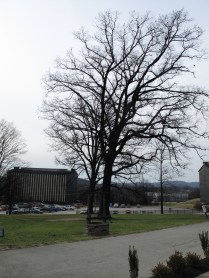
Evidence of the Angel’s Share. This is a healthy tree.

The angels get a share as well. A fair amount of alcohol evaporates during the distilling and aging processes. This evaporation causes a fungus to grown on the bark of surrounding trees and bushes, giving them a black color. That black color is the evidence of the angel’s share. Every day, the angels watch over the process, guaranteeing a good batch, so I guess they earn their share.


Posted in USA Travel | Leave a comment

Road Trippin’ IVa

Almost ten years after the cross country road trip with son Sean, Mark and I took two road trips to warmer climates. In January, we drove to Florida and back, and in February, we drove to Arizona and back.

On the first day of our Florida trek, our new SUV packed, we headed out with the intention of going as far as we could before stopping for the night. We reached Cedar Falls, IA in time for lunch at the local Maid-Rite. We’ve enjoyed many Maid-Rites in our home town, so we figured we need to try this one out.

Maid-Rite has been around since 1926, started by butcher Fred Angell in Muscatine, Iowa. There are several locations in the Midwest, mostly in Iowa. If you haven’t had one, it’s a loose meat sandwich made with crumbled ground beef and spices, like a sloppy joe without the sauce.

IMAG0063

After lunch, we went in search of the Iowa 80 Truckstop, which bills itself as the world’s largest truckstop. It is certainly the largest one we’ve ever seen. There are a couple of restaurants and a very large store, as well as a theater and barbershop, and showers for truck drivers. You can get anything you need for your truck, or even place an order for a new truck.

Iowa and Illinois had been hit with a snow and ice storm the day before, so we saw quite a few cars in the ditch. At one point, the saw the aftermath of a crash between two semis. Traffic was backed up for a few miles, moving at a snail’s pace as the accident was being cleaned up. One trailer appeared to have been cut in half, the other was pretty beat up as well.

The next day we drove to Lexington, KY, where we visited the largest independently owned bookstore in Lexington – Joseph-Beth Booksellers. The name comes from the middle names of its founders, Neil and Mary Beth Van Uum. While we were there, we picked up a book about Kentucky Bourbon, since we were now in official bourbon country.


Posted in USA Travel | Leave a comment

Road Trippin’ III

Rolling JunkWorking my way through the best books about cross country travel, I’ve started one about a trip from New York to Alabama: The Cruise of the Rolling Junk by F. Scott Fitzgerald. At first, I thought Junk referred to the state of the car, or the fact that it was filled with junk, but after reading a review, realized that Fitzgerald meant the ancient Chinese sailing ship called a junk.

In 1920, just months after they were married, Scott and Zelda set off from their home in Connecticut to find biscuits and peaches in her home of Alabama. They set out with very little money and an unreliable car (so the title really could be referring to the car.) The car was a used 1918 Marmon, built by the Marmon Motor Car Company of Indianapolis. The company operated from 1902 to 1933, and was known for building both touring cars and racing cars.

Two years after this trip, in need of money, as always, Fitzgerald wrote about the journey, hoping to sell it as a three-part journal to the Post. He was turned down, and tried a few other avenues, finally selling it for only $300 to Motor Magazine.

Fitzgerald’s writing is beautifully descriptive, and I can almost see the areas he and Zelda are driving through. Their escapades surely inspired some of his later writings. It is a short book, easily read in an hour or two, perhaps while you are riding shotgun on a future road trip.

We haven’t taken a similar trip from Northeast to Southeast, but we did do two different road trips in 2012, during which we put over 6,000 miles on our car in two months. The first was from Minnesota to Florida and back, the second from Minnesota to Arizona and back.

Stay tuned.

Posted in USA Travel | Leave a comment

Road Trippin’ IId

Wyoming to home.

It would be wrong to drive through Wyoming without stopping at Devil’s Tower.

I had visions of Richard Dreyfuss molding a replica of the tower out of his mashed potatoes. I didn’t realize this at the time, but we were visiting only one month shy of the  25th anniversary of the release of the movie Close Encounters of the Third Kind. In the movie, various characters, including the one played by Dreyfuss (Roy Neary), have experienced close encounters with UFOs. Airplanes that had been missing for decades suddenly reappear in the desert; a child’s toys begin operating on their own, and Roy can’t stop obsessing about a mountain-like shape.

Back to the road – we approached the Devil’s Tower National Monument in the afternoon. The tower is an isolated rock formation about 60 miles north of I 90 near the eastern edge of Wyoming. Scientists agree that it was formed by an igneous intrusion, but they don’t agree on how it got there. In any case, it was exposed as the softer rocks and minerals surrounding it eroded away. It is just under a mile in elevation, at 5,112 feet.

From here we  went to Rapid City, where we stayed the night. While waiting to check in at the hotel, I noticed that many of the guests were focused on the lobby television. I turned to look, and learned that Senator Paul Wellstone, his wife and daughter along with three members of his campaign staff , had been killed in a plane crash in northern Minnesota, where he had been campaigning for reelection.

Former Senator and Vice President Walter Mondale came out of retirement and stepped forward to take Wellstone’s place on the ticket. He narrowly lost that election and stated that he would not seek election again. Interestingly, Wellstone’s name was still on the ballot and he received over 10,000 votes.

I once read that Minnesota had the most liberal Senator (Wellstone) and the most conservative Senator (Rod Grams) serving in the US Senate at the same time.

The next day, we drove through the badlands on the way home. Badlands National Park is a 244,000 acre  in southwestern South Dakota with stunning geologic formations. The badlands were formed in layers composed of sediments such as sand, silt and clay that formed sedimentary rocks.

The layers were deposited over many millions of years, during which time the land was ocean bottom, tropical land, and open woodland with meandering rivers. About 500,000 years ago, erosion began wearing down the layers that were put down over those millions of years, leading to what we see today.

This story comes to an end, just as I finished reading the book that inspired the past few blogs: Cross Country, etc. by Robert Sullivan. By the way, I loved the book. Your library might have it, or you can get a used copy for a pittance.


.

Posted in National Parks, USA Travel | 1 Comment

Road Trippin’ IIc: Yellowstone

Don’t enter Yellowstone in late October without tire chains. The signs were very clear about this, but the sky was very clear as well.

After visiting Cicely, we drove through northern Idaho which is stunning with its mountains and forests. Looking back, the peaks weren’t terribly high there, but I did wonder if Sean’s Corolla was going to make it up some of those rises. It was slow at times, but it always reached the top.

We wanted to see Old Faithful so we headed to Yellowstone National Park. In spite of all of the warnings, we decided to go into the park that afternoon with no tire chains. Surely the weather wouldn’t change on us. We wouldn’t be there that long, just long enough to see the geyser.

We saw lots of wildlife in the park: deer, buffalo, even a coyote in the parking lot that seemed to be unafraid of us. Perhaps people have been feeding it so it was hoping for something from us. Coyotes were often destroyed in the early 1900’s because they sometimes preyed on livestock. Their ability to adapt and the elimination of wolves have helped their numbers to increase.

Wolves had been released into the park in the mid to late 1990’s, and numbered at least 272 in 2002, but we did not see any on this trip.

Yellowstone is the only place in the United States where buffalo (bison) have lived continuously since prehistoric times. The park has the largest bison population on public land, about 2,200 in 2002, and are among the few herds that have not been interbred with cattle.

We arrived at the site of Old Faithful, a cone which doesn’t erupt quite so faithfully as legend would have it do. The interval between eruptions averaged about 45 minutes at the time, but could certainly be longer. The interval has increased over the years, possibly due to earthquakes affecting water levels underground. Between 1983 and 1994, probes were lowered into the geyser to measure temperature and pressure. At 72 feet, the temperature was 244 degrees. During an eruption, the water temperature at the vent has been measured at 204 degrees and the steam temperature above 350 degrees.

In the early days of the park, Old Faithful was often used as a laundry. People would place their garments into the crater while it was quiet. When Old Faithful erupted, the garments would be ejected thoroughly washed. Cotton and linen fabrics were not harmed, but wool would be shredded.

While waiting, we walked on the boardwalk around the geyser area and read the signs that gave some history of Old Faithful and the many other geysers and hot spots in the park. The wait was worthwhile, although it was getting late in the afternoon and we really needed to be on our way.

I had never seen the Grand Tetons, so we planned to stop in Jackson Hole, WY for the night. Normally, this would have taken about two hours, so we weren’t concerned. However, it started snowing not long after we started driving. Before long, it was dark and the snow was blowing fairly hard. It was difficult to see the side of the road or any oncoming traffic – not that there was any. There also was no restaurant, no gas station, and no lodging that we could see, and no tire chains on that little Corolla. Sean was driving, and I was happy to let him do so.

It was well after dark when we arrived in Jackson, but we were able to find lodging and plenty of restaurants to pick from.

The next morning, the Grand Tetons were fogged in, and we weren’t interested in staying around for the fog to clear. It’s an excuse to go back.


Posted in National Parks, USA Travel | Leave a comment

Road Trippin’ IIb: Roslyn, Washington

Northern Exposure, Roslyn, Washington

Sean and I are both fans of the television show, Northern Exposure, which aired from 1990 – 1995. This was one of the few shows that I caught from the very beginning, since even the ads were quirky enough to grab my attention. It was an intelligent comedy, with enough drama to keep me interested. The characters were likeable, even the irascible Maurice Minnifield.When I try to decide who was my favorite, I have to say most of them were: Chris Stevens the DJ/philosopher, Ed Chigliak the filmmaker wannabe, Ruth Anne Miller the elderly shopkeeper make the top three for me. Of course, I liked Joel and Maggie and Marilyn and Hollis and Shelly and Maurice and ….

I think every member of my book group was hooked on the show – we met on Monday evenings and would always break up in time to get home to watch the current episode. This was in the days before DVRs.

The show was set in the fictional town of Cicely, Alaska, but Roslyn provided the backdrop. Fortunately for us, it was on our route, just a few miles off of Interstate 90, although I believe anything within a hundred miles of our route would have been close enough.

Downtown Roslyn was no bigger than downtown Cicely was. Roslyn’s Cafe (actually the Roslyn Cafe with “‘s” added for the show sits one one corner, about a block from The Brick bar and restaurant where Holling and his sweetheart, Shelly, held sway. Also on main street are the storefronts for Dr. Joel Fleischman’s office and the KBHR radio station where Chris worked, most memorably as “Chris in the Morning.” Chris played an ecclectic selection of songs which was part of the show’s appeal. No moose on main street, however. We also drove up the hill to Maurice’s home, and viewed some of the other houses that were featured in the show.

So happy that we stopped here.

Posted in USA Travel | Leave a comment

Road Trippin’ IIa

Seattle, October 2002

I flew out to Seattle to help my son, Sean, move back to Minnesota. My parents drove me to the airport very early in the morning, but not early enough to miss bumper-to-bumper traffic in the Twin Cities. I arrived at the airport with barely a minute to spare, and ran to catch my plane before the doors closed. Once on board, a flight attendant announced that there were some First Class seats available for an extra $75. My hand shot into the air: Pick me! Pick Me! The comfort of First Class helped to assuage my stress, which was pretty high by this time.

Sean picked me up at the airport, and we made a plan for getting his things packed and transported to Minnesota. In between packing, Sean took me to see some of the sights, including the Space Needle, Pike’s Market, and a bar or two.

Although we didn’t take the Space Needle, we enjoyed some of the other attractions at Seattle Center. There is the Experience Music Project, built only two years earlier, which celebrates modern film and and music, of special interest to Sean.

I loved the International Fountain, built for the 1962 World’s Fair in Seattle, or Century 21 Exposition, and remodeled in 1995 to be more child friendly, with a splash area surrounding the fountain. It’s a popular attraction for visitors and residents of all ages.

We also visited the Seattle Japanese Garden, a 3.5 acre formal park built in 1960. Kiyoshi Inoshita and Juki Iida designed the project and supervised the construction. Most of the construction workers were local Japanese-American gardeners. Many of the granite rocks were brought in from the nearby Snowqualmi Pass. Located within the Washington Park Arboretum, it is a peaceful sanctuary in the city.

When I look through my photos, they are definitely of good quality, plus I wasn’t quite as fanatical about taking an excessive number of shots. Today’s digital camera could be cited as enabling this bad habit of mine. When I had to pay for processing, I was much more selective.

Pike Place Market was another delightful destination. This farmer’s market was established in 1907, the anchor of the historic district of Pike Place Neighborhood. The market includes food, of course, but also artwork and crafts by local artisans.The Pike Place Fish Market is known for fish throwing. Once a customer purchases a fish, it is tossed by a fishmonger to another employee to wrap the fish. This practice is accompanied by loud shouting back and forth.

There was not enough time to fully appreciate the attractions of Seattle, as we needed to get on the road. I’ll have to go back some day.


Posted in Seattle, USA Travel | Leave a comment

Road Trippin’ I

In an earlier post, I referenced an article about road trips and literature. Inspired by that article myself, I decided to start reading some of the books on the list that I haven’t read before. My first is Cross Country: Fifteen Years and 90,000 Miles on the Roads and Interstates of America with Lewis and Clark, a Lot of Bad Motels, a Moving Van, Emily Post, Jack Kerouac, My Wife, My Mother-in-Law, Two Kids, and Enough Coffee to Kill an Elephant by Robert Sullivan. The title of this book may be longer than this post.

Cross Country

Sullivan’s writing style is conversational, even while presenting some American, history along the way. The reader follows him and his family as they take one of their annual trips Oregon to New York. The road trip is interesting enough, but what I find most engaging are the stories he tells along the way: experiences that he and his family have had at various stops on earlier trips; and history of the peoples who have lived there or stopped there in the past. He seems to discover something new every time.

While reading this book, I was reminded of a couple of my favorite cross country trips. Actually, they are semi-cross country, since one was from Washington State to Minnesota, and the other was from Minnesota to Maryland and back.

The trip from Minnesota to Maryland was the first one that I wrote about in this blog in August, 2013. My first post was titled “On the Road With Ed and Paul,” and it was intended to let other family members follow this trip with my father, Ed, and brother, Paul. It segued into a travelogue with over 120 posts to date.

The trip from Washington State to Minnesota was with my son, Sean, in October, 2002, which I will write about in my next post.


Posted in USA Travel | Tagged , | Leave a comment

Road Trips and Literature

Two of my favorite things.

While this isn’t about my travels, it is inspiring some future trips as well as some future reading. Check out The Obsessively Detailed Map of American Literature’s Most Epic Road Trips. Richard Kreitner wrote this article in his Atlas Obscura blog, and Steven Melendez created the map. It touches 48 states and bits of Canada and Mexico. Only Alaska and Arkansas remain unexplored by this list.

Mr Kreitner chose twelve books for his article, and plotted the trips taken in each. I’ve only read two of the books he cites: Wild by Cheryl Strayed, and Zen and the Art of Motorcycle Maintenance by Robert Pirsig. Perhaps I’ll tackle The Cruise of the Rolling Junk by F. Scott Fitzgerald next, although Cross Country by Robert Sullivan is calling me as well.

I do have to point out that three of the twelve books are written by Minnesotans. Make what you will of that.


Posted in USA Travel | Tagged , | Leave a comment