It’s Never Too Late!

I just read this article about a 90 year old woman, diagnosed with cancer a little over a year ago, who decided to forego treatment and hit the road with her son. The article, written by David Wolfe, is titled 90-YEAR-OLD is Told She Needs Chemo for Cancer. What She Does Next is the Best Ever!

She has a Facebook page, DrivingMissNorma, with over 18,000 followers. I’m one now too. A recent post indicates that her health is declining, and her journey on earth may soon be over. Sad, but I’m pleased that she made the most of this past year.

Norma, you are an inspiration.


Posted in Uncategorized | 3 Comments

Book Report: “On the Road” by Jack Kerouac

When I was in high school almost half a century ago, I was taught the proper punctuation for book titles, magazine articles, etc., but now I’m no longer sure. I’ve used italics, quotations marks, sometimes bold face. I decided to look it up before writing this article so my punctuation would be correct. According to The Punctuation Guide, book titles should be set in italics. Since I can’t italicize the heading, it will be in quote marks.

Cover art

On the Road is one of the books listed in the Atlas Obscura article by Richard Kreitner and Steven Melendez: “The Obsessively Detailed Map of American Literature’s Most Epic Road Trips.” All punctuation have been verified with The Punctuation Guide, at least as I interpret it. Where’s Sister Michael when I need her? Only for punctuation, mind you – she wasn’t one of the nice ones.

I had certainly heard of this book over the years but had never read it. The  novel, written in 1957, the story is based on Kerouac’s own travels after a short sojourn in the Navy during World War II.

Kerouac was born the same year as my father, so it was interesting for me to contrast his youthful experiences to my father’s more sober ones. While Dad was trying to establish himself as a farmer and starting a new family, Jack was crisscrossing the country in search of “wine, women and song,” or booze, jazz, grass and sex.

The word that keeps coming to the forefront when I try to describe Kerouac’s writing style is exuberance. The reader catches his energy and excitement as he and his varying group of friends go in search of life. The friends in the book are loosely based on many of Jack’s real life friends, such as Allen Ginsberg, William S. Burroughs, and Neal Cassady, all writers themselves.

While there aren’t many descriptions of the places that he traveled to and from, the descriptions of his companions and their lives on the road are beautifully written. Some of the language was unfamiliar – words and their meanings keep changing through general usage. The word “beat” is frequently used to describe something awesome or great.

On the Road is credited as being a defining work of the Beat generation. I remember the term “beatnik” from my childhood, and my impression was that they were poets and writers who read their works to small groups of people in coffee houses, and really didn’t contribute much to society. This image was presented quite well in the old TV show The Many Loves of Dobie Gillis. Dobie’s beatnik friend Maynard G. Krebs was depicted as a person who avoided work and commitment at all costs.

Do I recommend it? Yes. Consider it an American Classic. It may help you understand the generation that grew up in another dimension surrounded by the one inhabited by your parents or grandparents.


Posted in Book Review, Jack Kerouac, Reading Group, Road Trip | Tagged , , , , , , | 1 Comment

Riding the Rails Again

Back on the Rails

Saturday, August 20, 2016

All good things must come to an end, and so it is with this fabulous trip to our nation’s largest state. We boarded the McKinley Explorer train for Anchorage this morning for a pleasant ride through this beautiful country.

The rail cars for the McKinley Explorer were built for Holland America by the Colorado Railcar Company. The ten total cars are named for rivers of Alaska – Chena, Chulitna, Eklutna, Kashwitna, Kenai, Knik, Kobuk, Nenana, Susitna and Teklanika. When we rode to Denali from Talkeetna we rode on the Teklanika car; today we are on the Kobuk car.

The domes on our cars are made up of three layers of glass, each layer just under ¾ inch thick. These windows are extremely strong, in fact bullet proof. Apparently, people have been known to shoot at the trains, not always accidentally.

IMG_8114

Each car is equipped with a diesel engine driven generator which produces enough electricity to power several households. It can be used as a backup generator if there is a problem with the electrical supply from the locomotive.

The wheels weigh over a ton each, but measure only 36 inches in diameter. They have a two part interface with the track, the tread which sits on top of the rail and the flange which keeps the train on the track.

The rail car truck, or the suspension, consists of several components including springs, shocks, bolsters and truck frame casings. The truck assembly without the wheels and axles weighs about 15,000 pounds.

We arrived in Anchorage around 5:00, checked in at The Hotel Captain Cook . Once again, Carlos did a great job, making sure all sixteen of us had transportation arranged to the airport tomorrow. I have nothing but good things to say about Escorted Tour Operations. Hopefully, they’ll be in charge of future add-on trips with Crystal, say in Machu Picchu next February?

We took a short walk before dinner, and came upon a sign indicating a stop for Mars along a planetary route. Curious as always, we went in search of the sun. The Anchorage Lightspeed Planet Walk is a scale model of the solar system, designed by Eli Menaker while he was a senior in high school. The Anchorage Rotary Club funded the project as its Centennial project for Rotary International. The project was completed in 2005, and formally dedicated to the city the day before Pluto was unceremoniously dropped from our solar system. The model of the sun includes sun spots; Mercury, the closest planet is less than a block away, Earth is about 2.5 blocks from the sun; and Pluto is 5.5 miles away.

We had a quick dinner at Orso, not far from our hotel. We weren’t very hungry, so ordered a flatbread small plate and cheesecake to share for dessert. Delicious!

Tomorrow, we fly back to Minnesota, where it isn’t much warmer than it is here. Should warm up soon, though.

Posted in Alaska, USA Travel | Tagged , , | 1 Comment

Denali National Park

Friday, August 19, 2016

Afternoon

When Denali National Park and Preserve was established in 1917, it comprised about 2 million acres at that time. More area was added in 1980, including some wildlife preserves, bringing the total park to over 6 million acres.

The original park area, Denali Wilderness, is a protected area where no hiking or camping is allowed. There is no interference with nature. Fires are allowed to run their course, low animal populations are not supplemented, injured animals are not rescued. Tourists can go in only by bus and they can only get out at the rest stops along the road. This is to protect the environment for the animals that live or travel through here. The animals do not associate humans with food, and they do not see humans leaving vehicles or walking in their areas so the buses can stop by the road and the animals will barely take notice.

The park operates several tours including the one that we took this afternoon, the Tundra Wilderness Tour, which went 60 miles into the park. The drivers, who also narrate the tour, are trained naturalists. Our driver, River, provided history of the area and the animals of Denali. He was good at sighting animals and quick to respond when a passenger saw one, pulling over to allow photos. He has been doing this for about 3o years.

When we do stop we are cautioned to keep our bodies and cameras inside the bus (although we can open the windows.) We are also asked to keep our voices low so that we don’t startle the animals.

IMG_8000

We were on the lookout for bears, moose, wolves, wolverines, the willow ptarmigan (Alaskan state bird,) Dall sheep, eagles, and much, more. Our first sighting was of several caribou, with some of them losing the velvet from their antlers before winter. The racks that still have the velvet are a soft brown color, and those that are losing the velvet will look pink because they bleed when the velvet peels off.

Are Reindeer and Caribou the same thing? For years it was thought that they were one and the same but more recent studies show that, although closely related, they have diverged somewhat after being separated geographically during the last ice age. Reindeer meat shows up on many menus – reindeer burgers, sausage, chili, etc. Don’t worry, it’s not Rudolph, just caribou.

Soon after, we saw a female bear and her two cubs, eating berries and shrubs close to the road. We watched them for several minutes as they were not afraid of the bus, and walked around and along side of us, providing great photo ops for all.

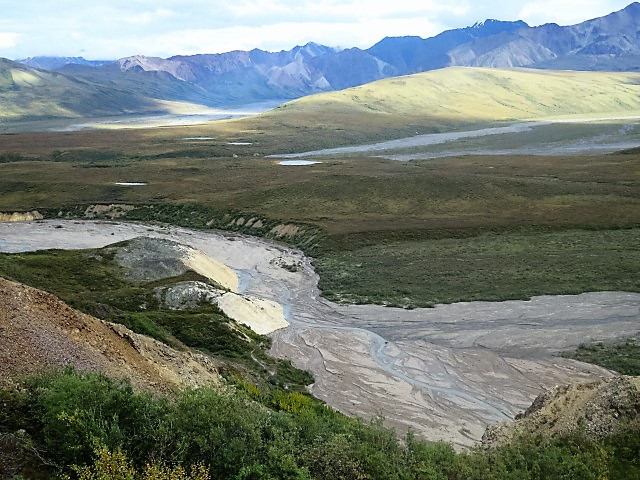
The scenery here is beautiful as well. The park contains mountains and rivers, and is surrounded by mountains as well. One area is called Polychrome Canyon because of the colorful hills there. If you look closely, you can see Dall sheep on the hillsides. Autumn is arriving already here in Denali, it seems almost overnight.

Several rivers run through the park. The river beds look very wide, which I thought must be from flooding, but River (our guide) explained that these rivers don’t flood. When the river freezes during the winter, it creates ice dams, so the flowing water needs to find another way to flow, increasing the width but not the depth of the river bed.

IMG_8037

After we left the protected part of the park, River asked if anyone wanted to get off the bus and walk on the tundra for about 20 minutes. He was going a little further into the park to do a turn around, and would pick us up later. Naturally, we jumped at the chance. River warned us to be respectful of the environment and to walk separately so that we didn’t walk in each other’s steps and do more damage to the ground.

I was surprised to see how spongy the ground was. We were walking on layers of moss and lichen, and could sink in a couple of inches. The foliage is very compact. Blueberry bushes grow very close to the ground, not more than a couple of inches tall. There were ferns that were only about one inch tall, almost impossible to see.

We feel very privileged to have had this experience. River said he rarely offers this opportunity, but we were the last bus of the day so he wasn’t concerned about crowding or delays. Lucky us!

The group was feeling a bit discouraged because we hadn’t seen moose. River said to have patience, that they often don’t show up until later in the day, and closer to the park entrance. He was correct. We were rewarded with several views beginning around 8:30 pm, of both cows and bulls. These animals are enormous!

Moose Cows

Moose Bull

This was a very long and rewarding day. We fell into bed after returning to our hotel around 9:30 pm. It will be hard to leave.


Posted in Alaska, National Parks, USA Travel | Tagged , , , , , | 1 Comment

On Top of the World

Friday, August 19, 2016

Morning

Healy, Alaska is about 350 miles from the Arctic Circle – so close, at 66⁰33’. Of course we had to go. This required rising at 4:30 am to catch a flight leaving the Healy airport a little after 6:00. We checked in at the log cabin terminal and met Caleb, the pilot for our Arctic Circle Air Adventure. Caleb flies for Northern Alaska Tour Company, a subsidiary of Warbelow’s Air, which specializes in charter air transportation throughout Alaska Arctic, and has been delivering mail, supplies, groceries and other cargo to small communities in Northern Alaska for almost 40 years. They will even pick up high school students to bring them to prom with other students. Most students in those remote communities are home schooled.

 Caleb flew a 10 passenger Piper Navajo that can be easily converted to a cargo plane as needed. Mark had the privilege of flying shotgun on the way up, which he was pretty excited about. He could watch the instruments and ask questions about the airplane’s operation.

We flew over the small town of Healy, a coal mining town of about 1,000 people. The mine is owned by Usibelli Coal Mine, Inc. and it operates year round, employing a little over 100 people. The coal here is very clean, with a very low sulfur value. Production is between 1.2 and 2 billion tons per year, and we were told that there is enough coal here for 300 years of mining. The coal is strip mined, and the ground then planted with trees.

There is a wind farm about 14 miles north of Healy, the Eva Creek Wind Project, which has been operating for about four years. This is the largest wind project in Alaska and it has a capacity of 24.6 megawatts.


We made a stop in Fairbanks for a fuel check, and then we were back up and headed to Coldfoot, Alaska. The town got its name during the gold rush when about 400 prospectors settled there. Those who remained named it Coldfoot to make fun of those who got “cold feet.” True story? Maybe.

This part of Alaska is considered to be an arctic desert. The temperature ranges from about 80⁰ above to about 80⁰below. It can sometimes be warmer in Coldfoot than in Denali. The snow all melts off, even in the mountains, beginning in May as the hours of sunlight increase.

Minto, a town north of Fairbanks, is one of the wettest areas of the state.

We flew over the small Koyukon Athabascan community of Stevens Village, in the middle of the Yukon Flats. In 2010, there were 87 residents who make a subsistence living here.

There is still gold mining in Alaska. The town of Livengood was founded by Jay Livengood in 1914 after the discovery of gold here. At one time there were 21 operating mines here. Today, there is only the Livengood Mine, owned by International Tower Hill Mines Ltd. which culls small pieces of gold from water.  It generates about $127,000 in gold every summer.

IMG_7842

Our flight route mostly followed the Trans-Alaskan pipeline, operated by Alyeska Pipeline Service Company, which stretches 800 miles from Prudhoe Bay to Valdez. The actual distance is 799 miles, but an extra mile of jags were built in to accommodate expansion and contractions and for seismic activity. Prudhoe Bay was chosen as the head point since it has the distinction of being the only port in Alaska with access to the Arctic Ocean that doesn’t freeze over in winter.

The pipeline was expected to be used for about 20 years, but is still in use almost 40 years later. Over 30 billion barrels of oil have been transported, and the current load is about 500,000 barrels per day. About half of the pipeline is above ground and about half underground. The oil comes out of the ground at about 150⁰. This temperature would melt the permafrost, thus damaging the support system for the pipeline. There is only one physical structure over the Yukon River – the pipeline bridge. The bridge is 2,000 feet long and was constructed in only two weeks!

We crossed the Arctic Circle at about 8:30 this morning. Caleb did a little bounce to make sure we were all awake at that point. He pointed out the dotted line but I couldn’t see it.

IMG_7852

We flew near the Brooks Range, which is actually part of the Rocky Mountain Range, before landing in Coldfoot where we boarded a van to drive about 10 miles to Wiseman, at latitude 67⁰12’, 63 miles north of the Arctic Circle – not quite the top of the world. The North Pole is another 1,500 miles north of here, and the northern most area of Alaska is almost 300 miles north. Wiseman has a year round population of about 12 – 15 people. Again, this is an old mining community. The log homes built here in the early 1900’s have been rotting at the bottom when the frost melts, and they are slowing shrinking in height. However, several are still occupied.

We met with Jack Reakoff who lives here with his wife and daughter. He was a boy when his parents moved here in 1971. Jack spent about an hour telling us about his subsistence lifestyle in Wiseman. He hunts, traps, fishes and gardens to provide his own food. The growing season is very short, about 6 weeks, but the intense suns allows the plants to mature quickly. Vegetables can be stored underground where the temperature remains a fairly consistent 40⁰. The river that flows by town keeps the ground from getting too cold.

The town of Wiseman is off-grid, so he provides his own power with a generator and solar panels, and uses high efficiency LED bulbs to light his home. In the winter, he runs the generator only about 4 hours per day to conserve energy. Also, he shovels snow around the cabin to retain as much heat as possible.

Jack serves on regional subsistence advisory committee for the National Park Service and the Alaska Department of Fish and Game.

Back in Coldfoot, we paid a visit to the Coldfoot Cafe at Coldfoot Camp, the northernmost restaurant, truckstop and bar in the United States. An Alaskan dog musher, Dick Mackey,  started selling hamburgers to truck drivers in 1981 out of an old school bus. Truck drivers were delivering materials for the pipeline, wanted to make this a more comfortable place to relax, so they started dropping off the packing crates that had been used to haul pipeline insulation. These crates were used as building materials. The truckers also helped Dick build the cafe.

At the time of the 2010 census, 10 people were living here. Our van driver, Jackie Veats, said she tried living and working elsewhere but found that Coldfoot was much more to her liking. Besides driving van, she is the local Postmaster. Mail is flown in to Coldfoot three times per week, and Wiseman’s mail is driven up there once a week.

We arrived back in Healy around 12:30 pm, just in time for the next adventure.
 

Posted in Alaska, USA Travel | Tagged , , | 4 Comments

Riding the Rails, Talkeetna to Denali

Thursday, August 18, 2016

On our final morning at the Talkeetna Lodge, we walked one of several trails on the property. We kept our eyes open for moose as one had been seen on the property in the last few days. Although Mark kept watching and listening, we didn’t see any, nor did we see any bear.

This particular trail could be called “the mushroom meander.” There was plenty of other foliage, trees, shrubs and flowers, but there was an abundance of mushrooms of several varieties. When we get back home, I’ll try to identify as many as I can. By the way, do you know the difference between mushrooms and toadstools? I didn’t either, so I looked it up. You can find anything on line. There isn’t any scientific difference, but people often used the term “toadstool” to describe a poisonous or otherwise inedible mushroom. Now you know!

We boarded the McKinley Explorer Train to head to our next destination, the Denali Princess Wildnerness Lodge, located about 150 miles from Talkeetna. This train line is owned by Holland America and Princess Cruise Lines.

The cars are domed with clear glass, enabling us to view the beautiful countryside during our four hour journey, part way along the Susitna River, part way along the Chulitna, and partway along the Nenana. Any word that ends with “na” refers to a body of water. In addition, we could step outside onto the landings at the ends of the cars to get up close to nature. It was a bit chilly for that, but worth it for some of the photo opportunities.

Besides the McKinley Express, there is The Hurricane Turn, a flag-stop train that picks up riders along the way. If you want the train to stop, put out a white flag, and it will pick you up. Ride as far as you need for $1.50 per mile. It runs from Talkeetna to Hurricane Gulch, which we crossed during our journey.

Tomorrow, we’ll be up super early for an exciting flight to the Arctic Circle. Just need to locate my warm clothes.


Posted in Alaska, National Parks, USA Travel | Tagged , | 2 Comments

The Great One

Wednesday, August 17, 2016

We’re staying at the Talkeetna Alaskan Lodge located about 50 miles from Denali’s base. The grounds here are beautiful, and the weather has allowed us to enjoy our surroundings so very much. The fireweed here are releasing their seed already, so that means six more weeks before the snow flies. The fireweed plant can send up to 80,000 seeds per plant flying on the wind.

We have been warned that Denali is visible only about 30% of the time. Denali is so massive that it generates its own weather system. Staff here reported that they hadn’t seen it for three weeks, so this was indeed our lucky day. We rose early and didn’t see too much at 7:30 am. However, the clouds began burning off, giving us a phenomenal view by 10:00 am.

Denali is the highest peak in North America, at 20,310 feet, and the third highest of the Seven Summits – the highest peaks on each of the seven continents. Scaling all seven is regarded as a mountaineering challenge.

Denali is so massive that it generates its own weather system. If you wish to climb it, you must first register at the Walter Harper Talkeetna Ranger Station, where you will meet with Rangers to review the rules and risks of the climb. It takes about two weeks, since a climber must stay at the various stations along the way to acclimate to the altitude. No oxygen is carried by the climbers and many will succumb to altitude sickness even though they exercise the proper precautions. Only about 1,200 are allowed to attempt the climb each year, and just over half will actually reach the summit.

Until last year, Denali bore the name Mt. McKinley, for a former president who never even visited here. For decades, Alaska had tried to get the name changed to Denali (from the word “deenaalee” from the Koyukon language meaning “The Great One”) but the state of Ohio always objected (President McKinley’s home state.)

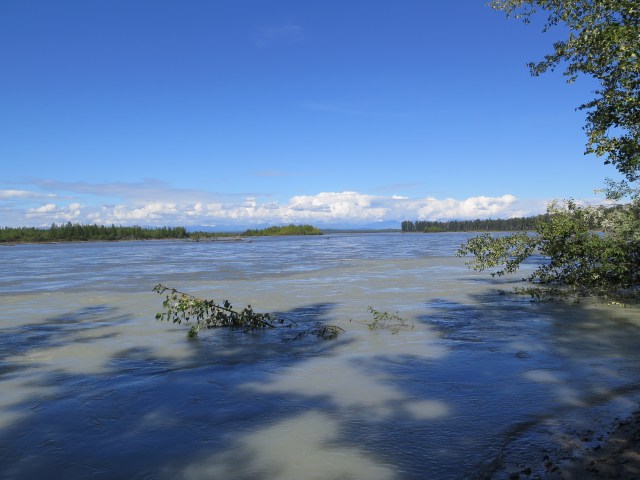
We hiked about two miles into Talkeetna , the town which supposedly provided the inspiration for one of my favorite television series – “Northern Exposure.” The town was founded 100 years ago as a district headquarters for the Alaska Railroad. It sits at the confluence of three rivers – Susitna (which was flowing very rapidly today,) Chulitna and Talkeetna.

IMG_7624

Rapidly flowing Susitna River, fed by recent rains

Its fewer than 900 residents thrive on tourism. There are several art galleries, a few restaurants, and plenty of opportunities to fish, boat, try a zip line, land on a glacier, or fly around Denali. However, I read a recent article in the Alaska Dispatch News about the pressure that tourism is exerting on this small town, which is expected to see 300,000 tourists this year alone.

We were warned to be on the lookout for moose, and did sight quite a few. They weren’t too intimidating.

The Denali Brewing Company is based here in Talkeetna. We stopped at their Twister Creek Restaurant to sample some Purple Haze, brewed with blueberries. What a great way to get our antioxidants.

After dinner back at the lodge,  we attended a presentation  by a local ranger, comparing the first successful ascent of Denali in 1913 to a more recent one that she had participated in. It is remarkable that those explorers, Hudson Stuck, Harry Karstens, Willy Harper and Robert Tatum were able to achieve their goal. Their venture took about four months, compared to a couple of weeks for today’s climber. They each brought about 200 pounds of provisions, compared to about 80 pounds today. Even though modern climbers have better, lighter equipment and clothing, and have more knowledge, it is still grueling.

Our ranger made her attempt about five years ago, but her group stopped about 3,000 feet from the summit. The decision to continue or not can be affected by weather, health, equipment issues – a poor decision can result in death. When asked if she would try again, she said she had grown up around here and always thought she should make the attempt, but she didn’t say she would try again.

Following the presentation, we stepped outside to enjoy the beautiful evening. Denali was mostly visible again. It looks like a different mountain at night. Mark’s reaction was “How can a big rock that never moves change so much?”

IMG_7673IMG_7679


Posted in Alaska, National Parks, Uncategorized, USA Travel | Tagged , , , , | Leave a comment

Object to Which the Action of the Sea is Directed

Tuesday, August 16, 2016

The name Alaska comes from an Aleut word meaning Great Land or Object to Which the Action of the Sea is Directed. The largest state geographically, it consists of over 663,000 square miles, almost as many square miles as there are residents – just over 738,000 according to the 2015 census.

The Russians claimed Alaska in the mid-1750’s and they offered it for sale to the United States a century later. After some negotiation, the US purchased the territory for $7.2 million, or about 2 cents per acre. It became our 49th state in 1959, just a year ahead of Hawaii. For a year, we had a 49 Star US Flag.

49star

Alaska’s primary industries are, in order, oil, fishing and tourism. Minnesota has nothing on Alaska when it comes to lakes – over three million compared to our 11,842.

We pulled into Seward on this beautiful sunny morning. It was such a treat to feel the sun’s warmth again.

We boarded a bus to our next destination in Denali National Park. The next phase of our trip is being coordinated by Escorted Tour Operations, which is connected to Princess and Holland America Cruise Lines. Our tour guide, Carlos Gomez, is working with sixteen passengers from Crystal, making sure we get where we need to be and our rooms are ready when we get there, and arranging tours as requested by each couple.
After boarding our bus, we drove a few hundred miles along Seward Highway, via Anchorage, through beautiful countryside. Why didn’t we drop anchor in Anchorage? It is possible to stop there, but scheduling issues can make this difficult.

On the way we stopped at Portage Glacier and Lake. There was a small town here before a catastrophic earthquake in 1964 caused the shoreline of the lake to drop and flood the town.

We drove past the stunning Cook Inlet, which experiences the third largest tidal fluctuation in the world. When the seawater rushes into the inlet, it creates a bore tide, at times large enough to surf on. The waves don’t get dramatically high (6 to 10 feet) but they can reach speeds of 10 to 15 miles per hour and last a mile in duration, providing a good ride for surfers. They can go on line to find the best times to ride the Alaska Bore Tide.

Our next stop was in Anchorage for lunch at Humpy’s Great Alaskan Alehouse, where we enjoyed some local beer and reindeer. Mark had a reindeer burger and I  had hunter’s pie, like shepherd’s pie but made with reindeer meat. Like most venison, reindeer is very lean and tasty.

Humpy’s promotes their own version of “Pay it Forward.” Any customer can purchase a drink, select a recipient, then post the drink receipt on the “Pay it Forward” board until that person comes in to claim it. Sadly, I didn’t see one for me.

After lunch, we continued on to Denali. We had one more stop near Wasilla, at the Iditarod Headquarters where we saw some 6 month old pups as well as some more mature dogs. The annual Iditarod Trail Sled Dog Race, held in February and March, commemorates a valiant effort to help the residents of Nome during a deadly outbreak of diphtheria in the winter of 1925. The city did not have enough serum to inoculate everyone and was not accessible by road or water. Twenty mushers and their sled dog teams relayed the serum 674 miles from Nenana to Nome in less than six days.

The Iditarod Trails runs about 2,300 miles between Seward and Nome. It had lay unused for almost 50 years but was reopened in the early 70’s and named a National Historic Trail in 1978. Most of the trail is located on public lands managed by the State of Alaska or federal agencies.

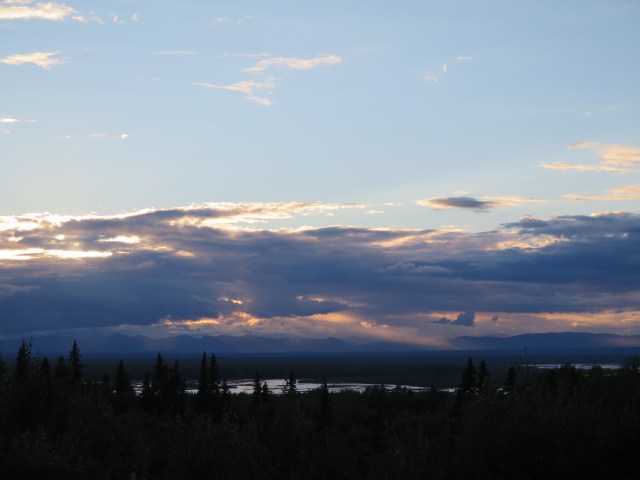
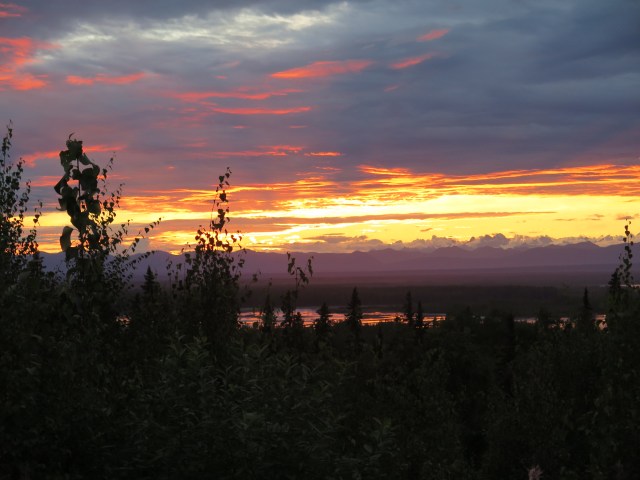
We arrived at Denali National Park in late afternoon. Couldn’t see the mountain, which is only visible about 30% of the time. We had a pretty nice sunset though.

IMG_7571

Posted in Alaska, Crystal Cruises, National Parks, USA Travel | Tagged , , , | Leave a comment

Hubbard Glacier


Monday, August 15, 2016

This is another day at sea, another rainy day at sea, another cold day at sea. The days here are getting longer as we travel further north – today we experienced almost 15.5 hours of daylight, and almost 2.5 minutes of sunshine.

Hubbard Glacier is 75 miles long and covers 1,350 square miles of land. It is the largest tidewater glacier in North America, with a 300 foot wall of ice rising from the ocean. Hubbard has been advancing for the last 100 years, and is considered a “healthy” glacier, one that is growing rather than receding. In May 1986, it blocked the outlet of Russell Fjord, creating Russell Lake. The water level rose over 80 feet. A few months later, the dam gave way and over 5 billion cubic yards of water gushed through in 24 hours, reconnecting the fjord to the ocean.

As we got closer to the glacier, we saw more and more icebergs floating near the ship. There were white bergs, blue bergs, silt filled bergs, and mixes of all three types.

We noticed icebergs popping up and down in the water as they split apart. We heard the glacier crack and split several times and were fortunate to witness some calving. Very impressive.

By early afternoon, we left the glaciers for our final sail toward Anchorage where we will be docking tomorrow.

Almost as exciting as the glacier was the glimpse of sunshine this afternoon. We could even venture outside for a short time without bundling up.

Posted in Alaska, Crystal Cruises, USA Travel | Tagged , | Leave a comment

People on the Outside of Baranof Island

Sunday, August 14, 2016, Sitka, Alaska

I’m thinking this is a pretty boring name for a town, but I didn’t pick it. When the Russians, led by Alexander Baranof, established a town here in 1799, they first called the settlement Mikhailovsk. The island that the town sits on is named Baranof. The Tlinglits weren’t too happy with Baranof’s invasion so they destroyed the Russian fort and killed most of its settlers in 1802.

Undaunted, Baranof returned a few years later and defeated the Tlinglits. He then build a new trading post named Nova Arkhangelsk (New Archangel.) This community thrived on trading for several decades until the Russians left in 1867. Not long after, Alaska was turned over to the United States and the community was renamed Sitka, from the Tlingit word She-it-ka, which means People on the Outside of Baranof Island.

Sitka was the first capital of the Alaska Provisional Government. The capital was moved to Juneau in 1906. Alaska became the 49th state in 1959. Sitka’s economy is dependent on fishing, timber and tourism.

Sitka Harbor

Downtown Sitka

We spent a few hours at the Sitka Sound Science Center doing a little volunteer work. The SSSC was part of Sheldon Jackson College, founded by Presbyterian missionaries in 1878 as a training school for native boys. The college closed in 2007 and the former campus houses a Fine Arts Camp for high school students every summer, as well as operating a salmon hatchery at the Science Center.

Some volunteers worked to harvest salmon for their eggs, some helped catalog equipment and documents, and we cleaned shelves – someone’s got to do it. The SSSC offers science classes for students in the summer, and were looking for help to clean up after the students went home.

After our work was done, we toured the facility and its aquaria, and watched salmon attempting to swim up stream into the collection basins. Three varieties of salmon are harvested here – chum (or dog), sockeye (red) and coho (silver.) After harvesting the eggs, they are manually fertilized, which results in a fertilization rate of 90% compared to only 5% in the wild. The salmon are also identified by region – this is done by examining the otolith, the ear bone, which has rings that will look different based on the temperature of the hatchery where it was incubated.

We walked around town a little bit, but are really not enjoying this cold rain. Cold is OK (just barely,) and rain is OK, but both together for days on end is not. However, that’s the Alaska rainforest, and it really is beautiful, and we’ve been told that the glaciers look more blue when it’s overcast than when it’s sunny – seriously, I look a little blue then too.


Posted in Alaska, Crystal Cruises, Uncategorized, USA Travel | Tagged , , | Leave a comment