“The Mapmaker’s Wife” – Another Book Review

December, 2018

The Mapmaker's Wife Personally, I find the title of this book to be a bit misleading. That didn’t prevent me from thoroughly enjoying it. I read The Mapmaker’s Wife: A True Tale of Love, Murder, and Survival in the Amazon, by Robert Whitaker in preparation for a trip we’ll be taking to the Upper Amazon next year.

Very little of the story is devoted to the mapmaker’s wife, Isabel Gramesón, the wife of Jean Godin. Rather, it is a story of physics, astronomy and geography, as well as of adventure and devotion.

In 1735, Jean Godin had traveled from France to Quito, Ecuador with a group of scientists whose goal was to precisely measure the distance of one degree of latitude at the equator. This expedition was undertaken to prove which of two theories about the shape of the world were correct, whether it bulges slightly at the equator, or whether it is shaped more like a football standing on end.

The only way to decide the argument was to get those precise measurements. If you are interested in physics and astronomy, this book explains how the scientists set out to take the measurements. During the expedition, they mapped much of the upper Amazon River, and also came to understand the effects of altitude on barometric pressure.

After their expedition was completed, Jean Godin married a woman of Spanish descent who was born in Riobamba, Peru. After about 8 years of marriage, Godin decided he wanted to return to his home in France. The normal route would involved a long trek over land to Cartegena, then boarding a ship to France. Godin wanted to go down the Amazon to the Atlantic, then board a ship. At this time, not many Europeans had ever navigated the entire length of the river, and there were no maps, so Godin decided to travel the river himself to see if it was possible. If so, he would return to his wife, again by river, and bring her back down.

Jean did make it to the Atlantic, but circumstances made his return impossible. After 20 years (years, not months), he learned that his father had died in France, and it was imperative that he go home soon. He sent a letter to Isabel, who decided to brave the Amazon to join her husband. She set out with two brothers, a nephew and several servants. Isabel and one of her slaves who had gone ahead were the only ones to complete the treacherous journey. Isabel survived a couple of weeks on her own in the Amazon, something that was unthinkable for anyone, let alone a woman.

The Amazon is not like the Mississippi. Yes, they both have mosquitoes, but the Amazon has anacondas, piranhas, vampire bats, jaguars, giant ants, and more. I hope we see them only from a distance when we are down there.


Posted in Amazon River, Ecuador, Peru, Uncategorized | Tagged , , , | Leave a comment

Still More Airplanes!

November, 2018

We flew into Dulles, Virginia for a wedding in Washington, DC. We decided to go to Dulles first since we hadn’t visited the National Air and Space Museum located there, and Mark seems to be on a mission to visit every airplane or space museum in the country.

Before flying out, though, we spent the night at MSP’s new airport hotel, the Intercontinental, which had opened only a month earlier. It’s not very busy yet, and some areas are not open. There is a bar on the top level of the hotel that provides views of the airport, with airplanes taking off and landing. It’s not open, but we were able to snoop around.


The meeting rooms and restaurants are very welcoming, with several options for small groups as well as large. One restaurant has an inventory of games, including a wall-sized Scrabble board, plus pool tables and shuffleboard.


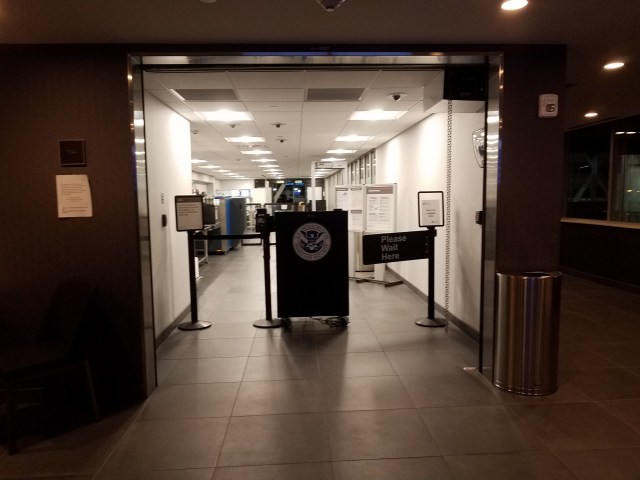
For the passenger traveling with carry-ons only, there is a TSA checkpoint on the third floor, so it’s possible to stay indoors all of the way from the hotel to the gate. For the rest of us with checked bags, the hotel provides a shuttle to the terminal.

20181031_063717

The Steven F. Udvar-Hazy Center is part of the Smithsonian National Air and Space Museum. It was established in December, 2003 with $65 million in funding provided by Steven Ferencz Udvar-Házy, an Hungarian immigrant who co-founded International Lease Finance Corporation, an aircraft lessor. Smithsonian’s Air and Space Museum on the Mall was not large enough to accommodate many of its artifacts, which were stored off-site.

We had visited DC early in 2003, so this was our first opportunity to see this facility, which is home to the Enola Gay, the Boeing B-29 that carried the atom bomb dropped on Hiroshima, Japan. My father was stationed on the island of Tinian at the time, and recalls seeing the Enola Gay the next day in broad daylight. He also saw “Fat Man,” the name given to the bomb to be dropped on Nagasaki a few days later, although he didn’t realize at the time that this was an atomic bomb.


The Space Shuttle Discovery reached its final home here in 2012, after making 39 flights between 1981 – 2011.


The museum is also home to a model of the Mother Ship in the movie Close Encounters of the Third Kind. According to the display, the team that made the model added some fun details, such as a Volkswagen bus, a submarine, the R2-D2 android, a US mailbox, an aircraft and a small cemetery plot. I do love a puzzle, so searched for these items while Mark was distracted by air and spacecraft. I did see R2-D2, some aircraft and the cemetery plot, but couldn’t find the other items. Actually, Mark found the cemetery plot as it was above my line of sight.


When we returned to our hotel, we arrived at the same time as seven buses of Honor Flight Honorees. We’ve never seen so many wheelchairs and oxygen tanks assembled in one place before. Seriously, we were pleased to see this group from Utah being honored. They were followed by several buses full of junior high hockey players, fortunately all staying in a different wing of our hotel.

We toasted them all at an outdoor firepit.


Posted in Aircraft, Smithsonian Museum, Spacecraft | Tagged , , , | Leave a comment

Frozen Waters Nine: Washington State

July, 2018

This is my final glacier post, at least for now.

We took an airplane flight from Boeing Field around Mount St. Helens and Mount Rainier.

Mount St. Helens has an ancient history of glaciation. When the volcano began to grow about 4,000 years ago, glaciers again developed, and by 1980, there were 22 named glaciers on its slopes. The eruption in 1980 destroyed most of them, resulting in a 70% decrease in glacier mass on the mountain. By September, 1996, there was evidence of a new glacier forming on Mount St. Helens, considered one of the world’s youngest glaciers.

Originally named Tulutson Glacier, and later renamed to Crater Glacier, it wraps around the growing lava dome. Normally, the elevation (6,561 feet) would be too low for a glacier to develop, but the crater walls shade the glacier from sunlight most of the year.

We were able to view Mount Rainier from the air and from land. The mountain has 25 named glaciers. Summit Crater Glacier sits at the very top of the mountain.

When we visited Mount Rainier National Park a few days later, we were able to witness several more, including Nisqually and Paradise-Stevens. Nearby Picket Range is home to a few glaciers as well.

The Picket Range in North Cascades National Park is home to Terror Glacier.

Posted in Glaciers, Mt St Helens, National Monument, Nisqually Glacier, North Cascades National Park | Tagged , , , | Leave a comment

Frozen Waters Seven: Antarctica

February, 2017

Antarctica is the fifth largest continent, covering 5.4 million square miles. There are three ice sheet covering about 98% of the continent, the Antarctic Peninsula Ice Sheet, the West Antarctic Ice Sheet, and the East Antarctic Ice Sheet. This is the largest single mass of ice on Earth, covering an area of over 5 million square miles, and containing over 60% of the Earth’s fresh water. In spite of that, Antarctica is a desert with only about 8 inches of precipitation per year along the coast, and less inland. There are numerous lakes and rivers, even a mountain range, under the ice.

There are hundreds of glaciers on Antarctica, and the weight of the ice has caused the continent to sink by .3-.6 miles. Most of what we saw was from the Antarctic Peninsula Ice Sheet. This ice sheet is widely regarded as sensitive to climate change due to its small size, and because this region has been warming rapidly. Several ice shelves have collapsed in recent years. An ice shelf is the floating portion of a glacier.

I just read a fascinating article on EcoWatch about the ice “singing” to the researchers monitoring vibrations on the Ross Ice Shelf. According to Rick Aster, professor of Geosciences at Colorado State University, “the tones in these signals shift when the surface of the ice shelf is disturbed by changes in surface dunes or near-surface melt.” The noises result when winds blow across snow dunes on the ice shelf.  It’s possible that scientists may be able to predict when ice shelves are about to collapse.

There was a very large iceberg, over 62,000 square feet, that broke off from the Larsen C ice shelf just a few months after our trip. In fact, we had been monitoring the news while we were there, since we knew that this calving was imminent.

In mid-October, 2018, NASA photographed a tabular iceberg that had calved off of the Larsen C ice shelf, that looks like a perfect rectangle, with 90 degree angles. It is rare, but not unheard of, to see an iceberg that looks so perfectly carved as this one.

We saw a small fraction of the glaciers on this continent, yet that was so much more than we’d seen anywhere else. We sailed east and north past Anvers Island, where Palmer Station is located. Palmer is one of three permanent stations on Antarctica maintained by the United States.

Posted in Antarctica, Glaciers | Tagged , , , , | Leave a comment

Frozen Waters Six: Chilean Fjords

February, 2017

By surface area, 80% of South America’s glaciers are located in Chile. There are five ice fields that feed the multitude of glaciers in Chile.

While cruising around South America, we stopped in Puerto Montt, Chile for a raft ride down the Petrohué River. Puerto Montt is located in the Los Lagos Region, near the northern edge of Chile’s Fjords. One of the highlights of the ride was the views we had of the glacier topped Osorno Volcano.

Further south, near Puerto Chacabuco in the Aisén Province, we saw more glacier topped mountains.

These glimpses merely served to whet our appetite for what was to come as our ship cruised deeper into Patagonia, through the Magallanes and Chilean Antarctica Region. When we reached the Amalia Glacier (also called Skua Glacier), our ship turned around so that passengers on both sides had good views. Amalia, a tidewater glacier, is located in the Bernardo O”Higgins National Park, and covers 61 square miles.

We got much closer to the Italia Glacier in the Alberto de Agostini National Park. Italia is located on a stretch of the Beagle Channel that’s known as Glacier Alley.

The city of Ushuaia, capital of Tierra del Fuego Province, is surrounded by the glacier covered Martial Mountains.

And, at sunset, those glaciers look like molten gold.

IMG_0117


Posted in Chile, Glaciers, Patagonia, South America Travel | Tagged , , , , , , , , , | 1 Comment

Frozen Waters Eight: Antarctic Islands

February, 2017

Decepción Island is the caldera of an active volcano which last erupted in 1970. Over half of the island is covered by thin glaciers. It is also covered with about 100,000 nesting pairs of chinstrap penguins. The volcano keeps the beach and surrounding waters, within about six feet, warm enough for swimming!


King George Island is the largest of the South Shetland Islands, with 15 named glaciers, plus more penguins and seals for your viewing pleasure. Our ship took a detour into Admiralty Bay to allow us to see these wonders.


Elephant Island is where Ernest Shackleton and his crew landed after having to abandon their ship, the Endurance, while on a mission to reach the South Pole. The ship was crushed by pack ice in the Weddell Sea in 1915, and they were stuck there for about 10 months before sailing three lifeboats to Elephant Island. From here, Shackleton and five crew members took one of the lifeboats to South Georgia Island, and then trekked 21 miles over ice covered mountains to reach a whaling station. Shackleton is the epitome of a hero, managing to keep all 28 members of his crew alive until they were rescued almost two years after they became iced in.

The day was cloudy, but we still managed to see a great deal of ice.


Posted in Antarctica, Glaciers | Tagged , , , | Leave a comment

Frozen Waters Five: Hubbard Glacier, Alaska

August, 2016

The largest tidewater glacier in North America, Hubbard Glacier is named for Gardiner Green Hubbard, a founder and first president of National Geographic. (This may be the most links I’ve ever had in one short sentence.) The 76 mile long glacier is joined by Valerie Glacier before it reaches Russell Fjord, with a width of almost six miles and a 300 foot face. It covers over 1,350 square miles of land. At this time, Russell Fjord is joined to Disenchantment Bay, although Hubbard has advanced enough in the past to block the fjord from the bay, and it is expected to do so again.

Approaching Hubbard Glacier from Disappointment Bay

Hubbard Glacier calves regularly, and while we heard it crack and split several times, we were never quick enough to witness the calving. As we approached the glacier, we saw more and more icebergs floating near our ship. There were white bergs, blue bergs, silt filled bergs, and mixes of all three types. We noticed some popping up and down in the water as they split apart.

In 1986, the glacier dammed the outlet of Russell Fjord, creating Russell Lake, where the water rose over 80 feet. A few months later, the dam gave way and more than 5 billion cubic yards of water gushed through in 24 hours, reconnecting the fjord to the ocean. There was another blockage and reopening in 2002. These glacial outbursts can cause serious damage to the landscape, homes and infrastructure in surrounding areas, not to mention the threat to human lives.

The Alaska Climate Adaptation Science Center is monitoring Russell Glacier as well as three other sites, including Mendenhall. The scientists have placed cameras and measuring equipment around these glaciers and lakes to gather data through real-time monitoring. With this information, they hope to be able to warn surrounding communities of impending danger.


Posted in Alaska, Glaciers, National Geographic, USA Travel | Tagged , , , | Leave a comment

Frozen Waters Four: Glacier Bay, Alaska

August, 2016

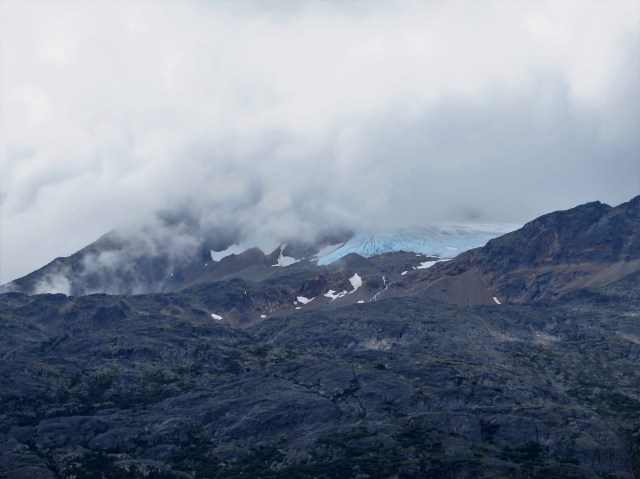
Before going to Glacier Bay, we took a train ride on the White Pass & Yukon Railway, from Skagway to the Canadian border. The route took us between mountains where we saw several glaciers.

IMG_7108

When explored by Captain George Vancouver in 1794, Glacier Bay was filled with a single great glacier that was more than 4,000 feet thick, up to 20 miles wide, and that extended more than 100 miles. When John Muir explored eighty-five years later, the ice had retreated almost 50 miles up the bay.

Glacier Bay National Park is comprised of over 3 million acres of stunning beauty, in which glaciers play a major role. The park is part of a binational UNESCO World Heritage Site and a Biosphere Reserve. There are eleven glaciers that reach the sea in Glacier Bay. These are tidewater glaciers, defined as valley glaciers that flow far enough to reach the sea. There are only three places in the world where you can see tidewater glaciers: Alaska, Chile and Scandinavia.

Tidewater glaciers calve many small icebergs. Though not as large as Antarctica’s icebergs, they can still cause trouble. We learned from park rangers who came onboard our ship, about different types of icebergs. White bergs hold trapped air bubbles; blue bergs are very dense and hold little air (they absorb white light while reflecting blue); and greenish-black bergs have calved off from the bottom of the glacier, carrying moraine, the rocky rubble picked up along their journey to the sea.

Icebergs come in many shapes as well. There are two basic shapes: tabular and non-tabular. Tabular icebergs have steep sides and a flat top, with a length that is at least five times the height (like a large sheet). Non-tabular icebergs have several different shapes: wedge (steep edge on one side and a slope on the other side), dome (rounded top), drydock (with a channel caused by erosion),  pinnacled (with one or more spires), and blocky (similar to a tabular, but the length is less than five times the height).  We didn’t see any large icebergs today.

We passed by Margerie Glacier, which is about 21 miles long, and growing at a rate of about 30 feet per year. This tidewater glacier was named for a French geologist and geographer, Emmanuel de Margerie.

Grand Pacific Glacier is a 25 mile long glacier that is located partly in British Columbia, Canada. This glacier is full of moraine and rocks from landslides that extend across almost two-thirds of the ice face. In some areas, this debris is more than 3 feet deep. The moraine helps insulate the ice, slowing the melting.


The approach to Johns Hopkins Glacier is quite dramatic. We caught glimpses of it behind a mountain before we reached the inlet where it’s located. This twelve mile long glacier is one of the few in the park that is advancing.


Posted in Alaska, Glacier Bay National Park, Glaciers, National Parks, Train Travel, UNESCO World Heritage Site, USA Travel | Tagged , , , , | Leave a comment

Frozen Waters Three: Mendenhall Glacier, Juneau, Alaska

August, 2016

IMG_6897

While on an Alaskan cruise, we stopped in Juneau, where we decided to take a helicopter ride to Mendenhall Glacier with  Temsco Helicopters, Inc.

This glacier has had several names over the years. The Tlingit People called it Sitangiospren (“the Glacier Behind the Town”) or Aak’wtaaksitkahan (“the Glacier Behind the Little Lake”). In 1888, John Muir named it Auke Glacier for the Tlingit Auk Kwaan. It received its current name in 1891, when it was renamed in honor of Thomas Corwin Mendenhall, physicist and geologist, who was responsible for defining the exact border between Alaska and Canada.

Mendenhall is a 13.5 mile outlet glacier of the Juneau Icefield, that terminates in Lake Mendahall. It’s located about 12 miles from Juneau. The glacier has been in retreat since the 1700’s. In 2012, an ancient forest was discovered when tree stumps and logs with roots and bark still attached emerged from under the retreating glacier. Scientists have determined that these trees are between 1,400 and 2,000 years old. Studying them can provide information on the area’s ecosystem before glaciers.

We flew over the glacier for several minutes, which allowed us to see the extent of it. From the air, it really does look like a river of ice.

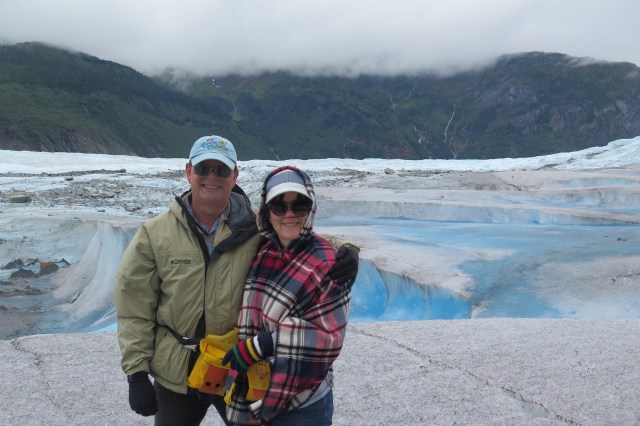
We then landed on the glacier, where it was very windy. The section where we landed is about 1.5 miles across. Mendenhall is in an “unhealthy” state, meaning it’s losing ice more quickly than it’s adding it. The ice is very wet, and we had to walk carefully to avoid falling. We scooped up some water to taste it – very cold!

The glacier looked exceptionally blue on this day. Our pilot told us that the does look more blue on a cloudy day than on a sunny one, so our timing was good. Glaciers expand and contract, with crevasses opening and closing over time. Any rocks that get caught in the crevasse will be crushed to a silty granular substance. One of the shops in Juneau actually sells glacier silt soap as an exfoliant.

It’s not necessary to take a helicopter ride to view the glacier, as the United States Forest Service operates the Mendenhall Visitor Center, open year-round, with several trails that provide views of the glacier and lake.

Posted in Alaska, Glaciers, USA Travel | Tagged , , , | 2 Comments

Frozen Waters Two: Iceland

May, 2014

IMG_0657The 269 named glaciers in Iceland cover 11% of the land, or over 4,000 square miles. Almost every type of glacier is represented on this small island nation. All of their drinking water comes from glaciers, and it does taste quite good.

Many of Iceland’s glaciers lie atop volcanoes. When a volcano erupts here, the lava doesn’t always reach above the ice. In 2014, Popular Science Magazine interviewed Benjamin Edwards, a geologist at Dickinson College in Pennsylvania, who explained that “if the lava stays contained within the ice, the biggest hazards will be local flooding. (These volcano-triggered glacial floods are called jökulhlaups.)”

Just take a drive around Iceland, and you will see several glaciers. Every glacier includes “jökull” in its name. This word comes from Old Norse, and means glacier, or a mountain covered with snow and ice.

To get up close and personal with a glacier, we hopped on a bus and headed to Jökulsárlón, a glacial lagoon that is fed by Breiðamerkurjökull, which is one of the 30 outlet glaciers of Vatnajökull, the largest glacier in Iceland.

Vatnajökull, which means “water glacier” in Icelandic, is an ice cap glacier, that is, a miniature ice sheet, covering less than 50,000 square kilometers (19,305 square miles). Vatnajökull covers 3,127 square miles, with an average thickness of 1,300 feet. It sits atop at least seven volcanoes.

Vatnajökull

Breiðamerkurjökull has been retreating since 1890. Land movements in the mid-19th century blocked the water’s passage to the sea, thus creating Jökulsárlón. It’s possible that future land movements could unblock the lake and it would be drained. As the glacier retreats, icebergs are calving and drifting through Jökulsárlón on their way to the North Atlantic Ocean. Their movement fluctuates with the tide currents and the wind. Once they are small enough, they finally make their way under the Glacial River Bridge and out to sea.

Breiðamerkurjökull calving into Jökulsárlón

Jökulsárlón has been featured in several movies, including two James Bond movies:  Die Another Day and A View to a Kill. It was also featured in Lara Croft: Tomb Raider. The lagoon does not freeze because of the inflow of salt water from the North Atlantic. For the movie Die Another Day, it was allowed to freeze over by blocking the flow of of ocean water into the lake.

Jökulsárlón’s icebergs near shore and drifting out to sea

We took an amphibian boat (aka duck boat) tour with Glacier Lagoon. We were close enough to the icebergs to touch them if we wished.

These icebergs look dirty because they carry volcanic ash from recent eruptions like that of  Eyjafjallajökull in 2010.

IMG_0609

Posted in Iceland, Volcano | Tagged , , , , | Leave a comment