But Wait! There’s More! Arequipa

Monday, January 28, 2019

We flew from Lima to Arequipa, Peru this morning. The city of Arequipa was established in 1540 by Garcí Manuel De Carbajal, a Spanish lieutenant who explored the area as an emissary of Francisco Pizarro.

The city sits within view of two volcanos: El Misti (still active) and Chanchani. Unfortunately, the skies were cloudy, so we didn’t get to see them. The population of Arequipa is about 1.5 million. The city’s industries include agriculture, cattle, mining, and alpaca clothing. Peru grows garlic, onions, 4,000 varieties of potatoes, 1,200 varieties of corn, 54 varieties of quinoa, asparagus, rice and vegetables. Guinea pig is a popular but expensive meal, and alpaca is also good to eat. Vegetables like asparagus are grown only for export because they are too expensive for Peruvians whose average salary is 600 soles per month, or about $200. Private schools are only available to the rich, since the tuition is usually more than 1000 soles per month, or $330.

The name Arequipa is a corrupted version of the Quechua words for Behind the Volcano. Quechua is still spoken by some people outside of the urban areas, but, like many other languages, is in danger of disappearing. Some schools are starting to teach the Quechua language in an effort to keep it alive.

At the center of the city is the Plaza de Armas de Arequipa, a designated UNESCO World Heritage Site. The buildings here were made out of volcanic sillar (a variety of rhyolite), so they are all white in color. Cars and taxis are banned from driving around the plaza.

Nearby is The Cloisters, which were originally attached to the cathedral. The rooms, used by Jesuit priests for residences, have been converted to small shops, restaurants and offices.

We visited the Monasterio de Santa Catalina, built in 1579 as a cloister for Dominican nuns. It still houses a small religious community in a newer part of the monastery. Several areas were severely damage by an earthquake in 2001. Built of volcanic sillar stone which is porous, the monastery has been damaged by air pollution as well. It was put on the World Monuments Watch in 2008, and work is being done to restore mural paintings in the church.

At the time the Monastery was built, the practice among Peruvians was to marry off the first daughter, send the second daughter to the convent, and require the third daughter to stay home to care for her parents. Novitiates could decide to leave the convent before taking their final vows, but most of the young women stayed. The nuns were cloistered, meaning they never left, even to visit family. Family could visit, but speak to the nuns only through a grate, and gifts had to be passed via a small door with a rotating cabinet. The nuns were silent except for one day per week, Sunday, and they could speak only in one designated area.

The monastery was unique in that it was structured much like a small town, the only such monastery in the world. Many of the nuns had their own house, complete with servants if they could afford them. In more recent years, the nuns moved to a newer monastery where they all live together, not in separate houses. Those who still live here make chocolates and other items to sell to visitors.

AC019C01-ED4E-40A6-8DB7-02DCA784C45E

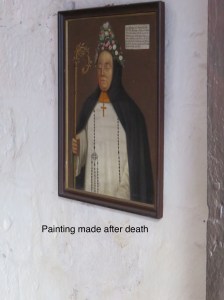
The pride of the convent is Blessed Sister Ana, who came to the monastery when she was 4 years old in the early 1600s. She had returned home at the age of 14, and her parents were planning give her in marriage. She had other plans, though, after seeing a vision of herself in a habit, and she secretly returned to the convent. Her parents objected strongly, but she was adamant, and lived there until her death in 1686. She was beatified by Pope John Paul II in 1985 after a miracle was attributed to her.

Posted in Peru, South America Travel, UNESCO World Heritage Site | Tagged , , | Leave a comment

Leaving the Amazon

Sunday, January 27, 2019

It’s hard to leave. We’ve had a wonderful time here, seeing and learning so much about the many beautiful birds and animals that live here. As we boarded our bus to the airport, we were greeted by several local children, many of whom had greeted us only a week earlier.

We stopped at the  Dallas World Aquarium Amazon Rescue Center. This rescue project was started eleven years ago as a partnership with the Dallas World Aquarium in Dallas, Texas, to rehabilitate manatees, monkeys, river otters, tortoises, turtles, macaws and other birds, then return them to their natural habitat.

Macaws continue to be hunted for their feathers. There are two Scarlet Macaws who had been captured and their wings clipped. They could not be returned to the wild because they could not survive there.

0E30613F-B2D3-490B-8EA4-6672A55F5A04

Monkeys have also been hunted and kept as pets. The center has several of different species.

Tortoises have been hunted for their eggs and shells. The females are prized, of course, because the eggs are considered a delicacy. There is only one way to tell if the tortoise is male or female. You need to flip them over and look at the bottom shell, which is flat on females, concave on males.

There is an 8-year old male ocelot that will never be returned to its natural habitat. It was orphaned and kept as a pet, so it has no idea how to survive in the wild. The center may move it to a zoo, if such a move becomes feasible.

River otters have been subject to illegal trapping. In addition to that, many of the waters have become polluted, posing another danger to the otters. They have been know to eat the plastic that’s floating in the water, dying as a result. There were also several white caimans that had been orphaned.

The Amazonian Manatee is the only manatee that lives only in fresh water. There are only about 20,000 left in South America. The manatee is a gentle and friendly creature, easy to capture. People kill them for food and for bait. The manatee feeds on the water lettuce that’s prevalent in the Amazon. Here, at the center, they need to be fed a special “milk” as well, which is very expensive.

Manatees can grow to 10 feet in length, and 1,000 pounds in weight. The males and females look alike. The only way to differentiate them is by the position of their genitals. Females have only one baby every five years. They can live to 75 years of age, but usually do not. The rescued manatees are tagged before release and tracked by GPS. So far, 23 have been released, and all are still alive.

6386DEAF-6CE1-4308-BAA6-37B52F141943

Most animals stay at the center for five years. They are quarantined for two years, closely monitored by the veterinarians before being placed with other animals. Then, they are weaned, meaning they are fed only the food that is available in their natural habitat, so they learn to forage or hunt for those foods when they are released.

The center has educational programs for children, hoping to break the traditions that have been passed down by their parents and grandparents. Hunting these animals has been part of the culture for many, many years, and it is difficult to convince the older people of the need to change, so they are targeting the next generation.

We then flew to Lima for an overnight stay. Before dinner, we visited the Museo Larco (Larco Museum), a privately owned museum of pre-Columbian art. The museum is housed in an 18th century building built over a 7th century pre-Columbian pyramid, with flower laden grounds. There were bougainvillea of several colors, beautiful blue plumbago, cacti and other plants we weren’t familiar with.

The museum was created by Rafael Larco Hoyle in 1926, starting with a collection of vases and other archaeological pieces that had been given to his father. Hoyle purchased two large collections to add to the original collection, bringing the collection to almost 15,000 pieces. It now houses over 45,000 pieces. It’s hard to believe there were so many artifacts that remained intact, not destroyed by the invading Spaniards.

Peru’s history dates back to 10,000 BCE. Since there was no written word, no way of knowing what the various peoples called themselves, they have been given names that coincide with the rivers where artifacts were found, in caves where the people lived. There have been many cultures in the millennia preceding the Incas, among them the Chimu, Moche, Nazca and Huari. These galleries provide an overview of 4,000 years of pre-Columbia’s history, detailing the development of metallurgy, pottery, textiles and agriculture, including elaborate aquaduct systems.

There are several permanent exhibitions with gold, silver and copper jewelry, pottery, figurines, ceramics, metals and sculpture. The metal work was very elaborate, with nose pieces, earrings, necklaces, breastplates and figurines. Elaborate textiles dating back centuries show the skill of these cultures. Some garments were made with feathers, many with beautifully dyed cotton threads. The dyes were all natural, the thread count was very high, as much as 300 per inch. One such fabric, about 1,000 years old, was declared a world record holder for thread count, and second world record for the fineness of the thread.

We also took a quick tour of the Erotic Gallery, which is exactly that. There are many figurines depicting childbirth, genitalia and various forms of sexual intercourse.

After dinner at the museum, we said good-bye to some of the friends we made in the Amazon. I really appreciated the small group, which provided the opportunity.to meet and get to know most of our ship mates.
Posted in Amazon, Amazon River, Ecuador, Lindblad, National Geographic, South America Travel, Uncategorized | Tagged , , , , , , | Leave a comment

Genovesa Island, Darwin’s Bay

Friday, January 18, 2019

This morning, we had a wet landing on the island of Genovesa, the most isolated of the main islands. A wet landing means that we step off of the zodiac into the water. High waves can make this especially adventurous.

Our ship anchored in Darwin’s Bay, a huge submerged caldera. Also known as “Bird Island,” Genovesa is home to many seabirds, including the red-footed booby, the Nazca booby, the great frigatebird, the swallow-tailed gull, and the Galapagos dove. The beach is beautiful, with coral and shells forming the sand. Red mangroves and prickly pear are abundant.

We observed a female and infant sea lion lying on the shore, then we walked along the beach, oohing and aahing at the many birds here. Each of the dominant bird species has staked out its own territory, although it’s not uncommon to see several perched on the same shrubs.


The red-footed boobies nest in the red mangrove bushes here. This is the only specie of booby that has prehensile feet, allowing it to perch in trees or shrubs. We saw many nests in the mangroves, some with eggs, some with chicks.

The Galapagos dove has a symbiotic relationship with the prickly pears on this island. There are no other pollinators on Genovesa, so the dove has taken over that role. In return, the spines of the prickly pear are relatively soft, as compared to the cacti on other islands, not unlike the hairs of a beard, which allows the dove to land on it. Another difference between the prickly pear here and those on the other islands is that is doesn’t form the hard bark. There is no need to add this protection since are no tortoises or land iguanas trying to feed on the plant.


Tidewater ponds hold lots of tiny fish, possibly pufferfish.


Several male frigate birds were hanging out with red sacs inflated, waiting for a female to notice them. I wished them luck.

Posted in Ecuador, Galápagos, International Travel, National Geographic, South America Travel, Uncategorized | Tagged , , , | Leave a comment

Genovesa Island: Prince Philip’s Steps

Friday afternoon, January 18, 2019

In the afternoon, we went ashore again, this time at Prince Philip’s Steps, named in honor of Queen Elizabeth’s husband when he visited this island. Before disembarking, our zodiac driver brought us to a spot on the walls of the cliff where Fur Seals were sitting. The Fur Seal is actually a sea lion, it received its name because of its fur. These animals have been hunted in the past for their skins.

After arriving at the steps, we hiked 90 feet up a rocky stairway through a narrow fissure to the cliff top, with the “steps” still slippery from the rain. Once at the top, the trail traverses a Palo Santo (holy tree) forest, where we saw red-footed boobies and Nazca boobies nesting. Oil from the Palo Santo tree is sometimes used in aromatherapy, and the wood can be burned like incense. It’s used in traditional ceremonies to ward off bad energy. Genovesa’s volcanic rock is slowly being broken up by plants, an early step in the process of creating soil.

The Nazca boobies lay two eggs, usually about 5 days apart. After both have hatched, one chick will push the other out of the nest, in order to guarantee enough food for itself. We did see a couple of examples of this “siblicide” in action. It’s hard to watch; we are tempted to rescue the outcast, but this is nature’s way of improving the odds of at least one surviving to adulthood. Both the Nazca and the blue-footed boobies use siblicide when there are two eggs, but the red-footed booby only lays one egg.

Unfortunately, not all of the remaining chicks make it to adulthood. There was a young Nazca booby that had died just short of maturity. The mother was staying near her dead offspring, walking over to it, even sitting on top it, trying to get a response. perhaps hoping it would come back to life. Again, sad to see. I do wonder how long the mother will wait before giving up.

We walked to a rocky cliff where storm petrels, frigatebirds and red-billed tropicbirds were fishing. This volcanic island is full of fissures, where the tropicbirds like to hide. We were able to find a couple of the tropicbirds inside the fissures, plus a few more sitting on the rocks.

Short-eared owls sit on the rocks waiting for their dinner. These owls dine solely on storm petrels, which become easy prey after the sun sets and they return to the land. It can be hard to spot the owls as they blend in with the background, and don’t move anything except their heads. They turn their heads back and forth, using echo location to find their prey.

Our guide told us about one short-eared owl who had successfully fought off three young males to keep his territory. Dubbed “Captain Jack,” by the guides, this owl lost an eye in the fight. The episode occurred about six years ago, and Captain Jack is still in control. We did see this owl as well as two more along the path.

We arrived back at our ship after a very satisfying day. We are ending our time in the Galápagos on a high, wishing we could stay longer. This place is magical – so many differences in terrain, flora and fauna from island to island. I have learned much about the various animals and birds living here, and about the efforts being made to keep these islands pristine, to allow the various species to live in their natural habitat. Hopefully, Ecuador can continue to keep the islands as they are.

Posted in Ecuador, Galapagos, Galápagos, International Travel, National Geographic, South America Travel | Tagged , , , , , | Leave a comment

Cerro Dragon and Guy Fawkes Island, Santa Cruz

Wednesday, January 16, 2019

This morning, we rode in a zodiac to Cerro Dragon (Dragon Hill), so named for its population of Galapagos land iguanas. The population was almost wiped out by feral dogs in the 1960s. A captive and semi-captive breeding program run by the Charles Darwin Foundation and the Galapagos National Park Service has helped the population to recover.

Early in the morning, we disembarked on the island for a walk over somewhat uneven, rocky land. Besides marine iguanas, we were treated to the sight of a pair of Blue-footed Boobies, a Blue Heron, some grasshoppers and a Galapagos Mockingbird, among others.

The plan was to next snorkel alongside Guy Fawkes Islets. Unfortunately, the other snorkelers were much more skilled than I am, so we returned to the zodiac after being left far behind.

We enjoyed a relaxing afternoon on the ship while it rained outside.

Posted in Ecuador, Galápagos, National Geographic, South America Travel | Tagged , , , | 2 Comments

Santa Cruz, Galápagos

Tuesday morning, January 15, 2019

Santa Cruz is the second largest island, and sits in the center of the archipelago. Its capital is Puerto Ayora, the most populated town in the islands, with a population of about 18,000.

We started our day by landing at the main town dock, then taking a bus to the Galápagos National Park Service, home of the Charles Darwin Research Station. One of our fellow travelers, Daniel, works at the station. As an employee, he was given the opportunity to join this cruise. Daniel is from New York, and he mentioned that many of the people who live here have never seen more than the island they live on. Also joining us on the cruise are five young people from the islands, who are being sponsored by National Geographic to train with the chefs on board.

Lonesome George was the last living Pinta tortoise, found in 1971. He was probably 150 years of age at the time. He had been alone for so long that he didn’t know what to do with the females at the station. It took about 10 years before he started mating. Several females did get pregnant, but none of the eggs were viable. However, some of his semen was collected and frozen before he died in 2012, in case scientists can find a better female match. His body was sent to New York for taxidermy, and his remains are now on display at the Research Station.

b4807ab9-64a2-45b2-80aa-88a212e4df7c

The Research Station collects eggs and keeps the tortoises in a safe environment until their shells become hard enough to deter predators. This takes about 5 years, after which they are repatriated to their natural environment. Almost 5,500 have been returned to the various islands since 1983.

After visiting the Research Station, we toured a local private school, Tomas de Berlanga School. At this school, the students learn in a natural environment – no windows in the classrooms. The school emphasizes care for the environment. About 90% of the students go on to college, with most of them coming back to Santa Cruz after they graduate.

After we returned to town, we stopped at the local fish market to watch the sea lions, pelicans and even a blue heron vying for any scraps. The heron chased all of the pelicans away – apparently this was his territory! He did leave the sea lion alone, though.


Posted in Ecuador, Galápagos, National Geographic, South America Travel | Tagged , , , | Leave a comment

Floreana, Galápagos

Monday, January 14, 2019

Our day started very early with a 6:30am walk with professional photographer, Walter Perez. We traveled to Punta Cormorant on Floreana Island, aboard a zodiac, then disembarked in shallow water – a “wet landing.” Early morning is the best time to find turtles before they return to sea, then to witness the flamingoes beginning to feed.

Floreana was named for Juan Jose Flores, the first president of Ecuador. This island has numerous extinct volcanic cones. While there is foliage here, the plants that rely on fresh water were still brown. With a little rain, they will green up again. Other plants that can survive with brackish (seawater mixed with fresh) water do seem to be thriving.

Ecuador had sent a group of convicts to populate the island in the 1800s, but that didn’t last long. It was a stopping point for whalers, and there is a spot where travelers would leave their mail to be picked up by another passing ship heading in the opposite direction.

Floreana is home to flamingos, shore birds, and a turtle nesting beach. After landing, we hiked to the nesting beach where we were treated to the sight of a few turtles on the beach, and many others in the water. The females come to this beach at night to lay their eggs, we were able to see their tracks as they made their way up the beach. Some turtles were mating in the water.

We also saw a yellow-crowned night heron, some least sandpipers and a semi-palmated plover, as well as a brown penguin and several frigate birds at this beach.

On our way to a brackish pond where flamingos nest, we saw a blue-footed booby feeding her chick. She would fly out to the sea for food, then return to her nest. The chick sticks its mouth into the mother’s mouth to take the food.

There were quite a few flamingos moving around. We were able to see a nest across the pond with several young chicks. The flamingos are white when they are born; they don’t acquire their pink color until they are old enough to begin feeding on the plankton in the pond. The mother regurgitates a type of “milk” from the plankton that she feeds the chick.

In the afternoon, we moved to a different beach on Floreana, at Post Office Bay. In the past, whale ships would stop here for water, and to drop off letters for home at the “Post Office.” Ships passing in the opposite direction would stop here and pick up whatever letters they could on their route. We wrote a few postcards and dropped them. We also picked up one to deliver to Plymouth, Minnesota. It’s not exactly on our way, but it will be fun to try to complete the delivery.


Posted in Ecuador, Galápagos, International Travel, National Geographic, South America Travel | Tagged , | Leave a comment

Española, Galápagos Islands

Sunday, January 13, 2019

The day started with a review of the rules of snorkeling – a good reminder since it’s been a few years since we’ve snorkeled. Then we were fitted with wet suits, flippers and masks. We had also been told to bring rash guards to protect us from the sun and from sea jellies (correct term for jellyfish here).

We are anchored near Española, one of the oldest of the islands, estimated at 4.5 million years.  It is slowly being reclaimed by the sea. The island is unoccupied by humans, but is home to marine iguanas and sea lions. We went to Gardner Bay to try out our snorkeling skills, while more experienced snorkelers went to deeper waters. Although Mark could have gone with that group, he stayed with me.

The water in Gardner Bay is quite warm, in the 70’s. We stayed near shore for our practice session, where high waves churned the water, making it difficult to see anything but the floaters in my eyes. Tomorrow, we can start snorkeling in earnest.

Lindblad/National Geographic offers several classes during the week. Today’s was on photography, so I went hoping to pick up a few pointers. I’m a rank amateur, I don’t have heavy, bulky equipment, I just have a passion to photograph the beauty around me.

Later in the afternoon, we returned to the island, at Punta Suarez, for a nice long hike. We engaged in boulder hopping most of the way, with the trail going through shrubbery and along the shore, to a cliff edge where many seabirds were soaring on the wind. There are lots of sea lions here (many females come here to give birth), along with crabs and marine iguanas. One sea lion was in labor, she was very uncomfortable and moaning in pain. We thought she might deliver before we returned from our walk but she wasn’t so lucky. By the end of our walk, she had moved to shallow water, but was still in pain.

Among the many birds were a few blue-footed boobies, Nazca boobies with eggs and hatchlings, some young wave albatross and the Espanola mockingbird. The mature albatross lay their eggs near a cliff. These large birds need to jump off a cliff to get enough lift to fly. Nazca young will play dead if they feel threatened.

Posted in Ecuador, UNESCO World Heritage Site | Tagged , , , | Leave a comment

San Cristóbal Island, Galápagos

Saturday, January 12, 2019

We had to leave the hotel in Quito at 5:30 this morning to catch a flight to our next destination. We arrived here in the dark and we are leaving in the dark. When we reached Guayaquil airport, we needed to purchase a tourist registration card. The Immigration Department here controls the number of tourists that may visit the islands on any given day.

The Galápagos Islands (official name Archipiélago de Colón) is a volcanic archipelago with 19 islands. The islands and surrounding marine reserve are located at the confluence of three ocean currents. They are isolated from other bodies of land, so that animal life has evolved in ways that are particularly adapted to their environment, different from their relatives elsewhere.

The Galápagos Islands are best known as the inspiration for Charles Darwin’s theory of natural selection. As a young man, he visited in 1835 to study the volcanic formations. While here, he was struck by how various species of bird and animal differed greatly from island to island.

The islands have been visited by many peoples, but there is no evidence of long-term occupation until the 1800’s. Ecuador annexed the Galápagos Islands in 1832, naming them the Archipelago of Ecuador. They were settled soon after by some artisans and farmers from the mainland. In the late 1800s, a few attempts were made to establish sugar cane plantations on San Cristóbal Island and Isabela Island. Over the next few decades, settlers arrived from Europe and the United States as well.

In the early 1900s, Ecuador attempted to sell the islands to raise cash. The US had expressed interest in buying them for military use, as they were strategically close to the Panama Canal, but they did not. However, the US was permitted to establish a naval base on Baltra Island during WWII. After the war, the facilities were given to the Ecuadoran government, which then established their own military base.

A large part (97.5%) of the Islands was designated a national park in 1959. The population at that time was less than 2,000 people. by 2010, the number had increased to over 25,000, many of them fishermen and farmers, who have resisted some of the restrictions imposed by the park service. There have been violent confrontations between some of the locals and the park service in the 1990s and 2000s. Illegal fishing within the reserve is a serious problem.

In 1978, UNESCO recognized the Islands as a World Heritage Site; in 1986, 27,000 square miles of ocean around the islands was a marine reserve; and in 1990, the archipelago became a whale sanctuary.

There are only about 500 native and endemic plant species here. Over the years, another 700 have been introduced, whether accidental or intentional, and they are taking over and eliminating the native species. Goats, dogs, pigs, rats, cats, mice, etc. have also been brought here, and they too are wreaking havoc on the native species on animals and plants.

We reached Puerto Baquerizo Moreno on San Cristóbal Island, the capital city of the Galápagos Islands, in the late morning. Here we were greeted by several sea lions and iguanas, while we waited to be transferred by Zodiacs to our ship, the National Geographic Endeavour II. There are 87 passengers aboard, along with 63 staff (biologists, guides, physician and crew).

After orientation, safety briefing and lunch, we returned to town to visit a local interpretation center at the foot of Cerro Tijeretas (Frigate Bird Hill), then took a short hike to observe the natural vegetation and wildlife (including a few swimmers below the hill). There were lots of small iguanas, several bird species, and some carpenter bees along the way.

It was a vigorous walk. There are over 80 tourist ships that operate within the islands. The government regulates which island each of those ships can visit each day. They also assign specific times that the ship’s tour groups can visit each of the sites. As a result, our time is short in any one spot. Also, the sun rises around 6:00am and sets around 6:00pm, another constraint on our time. All parks must be vacated by sunset.

Posted in Ecuador, Galapagos, National Geographic, UNESCO World Heritage Site | Tagged , , , , | Leave a comment

Last Day in Mashpi

Friday, January 11, 2019

On this, our last day in Mashpi, we took a short hike where we observed a few more birds, butterflies, and even a millipede and an iguana. The iguana flexed his throat in agitation, he looked almost fluorescent against the wall he was occupying.

We left Mashpi at 11:30 for our bumpy, winding trip back to Quito. It’s a bit of a bone shaker. If we weren’t wearing our seatbelts, we’d find it difficult to remain in our seats.

We get up very early tomorrow morning, so it was early to bed tonight.

Posted in Ecuador, National Geographic, South America Travel | Tagged , | Leave a comment